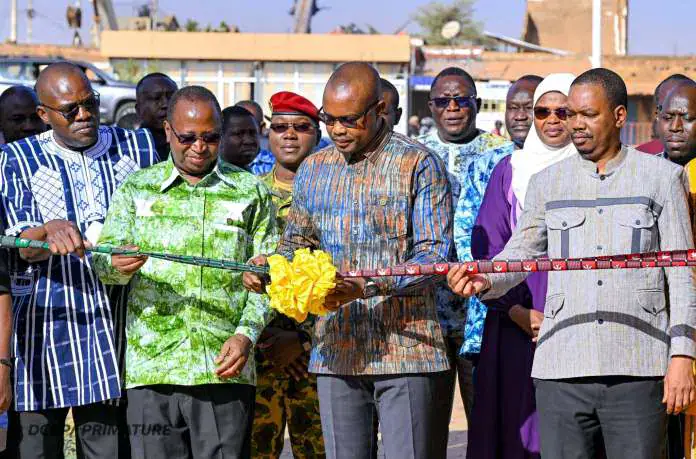
On November 26, 2026, in Ouagadougou, Burkina Faso's Prime Minister, Rimtalba Jean Emmanuel Ouédraogo, inaugurated the University Virtual du Burkina Faso (UV-BF) and two Espaces numériques ouverts (ENO) located in Bonheur-Ville and Tampouy. These new facilities aim to modernize the country's education sector and provide better learning conditions for students. The UV-BF and ENO are part of the government's efforts to improve education and meet the needs of the modern world.
The UV-BF features a four-story building with a sub-basement, sports facilities, and community spaces, built at a cost of 6.9 billion francs CFA. The building houses seven meeting rooms equipped for video conferencing, a multipurpose room, 71 offices, a virtual reality laboratory, an audiovisual production studio, a mini data center, a monitoring room, and 28 technical rooms. These facilities will enhance the learning experience for students across the country.
The two ENO, located in Tampouy and Bonheur-Ville, were built at a cost of 3.2 billion francs CFA each. Each complex includes an auditorium that can accommodate up to 300 people, two open workspaces, a training room, offices, and several technical rooms. These digital spaces will serve as community hubs, providing access to education and technology for students and residents.
According to the Prime Minister, these new facilities demonstrate the government's commitment to prioritizing education and human development. He emphasized that these investments will modernize education, increase capacity, and consolidate the central role of youth training in the country's progressive revolution. The facilities will also help address geographical and social accessibility challenges in higher education.
The Minister of Higher Education, Research, and Innovation, Pr. Ardjouma Thiombiano, explained that the goal is to provide accessible education for all, regardless of location or social status. He highlighted the potential of distance learning to mobilize skills and involve teachers from other institutions, including those from the diaspora and foreign universities. This will create new opportunities for students and enhance the quality of education.
Student representative Tindegma Zongo welcomed the new facilities, which address several challenges faced by distance learners, including limited access to computer equipment, internet connectivity, and pedagogical support. He expressed enthusiasm for the new university and promised that students would contribute to maintaining the facilities through discipline, responsibility, and a pursuit of excellence.
University President Oumarou Zalé expressed gratitude to the government for their support in realizing these projects. He emphasized that these facilities mark a significant milestone in the university's development, enabling it to strengthen its operational capacity and improve student support. Additional infrastructure is planned for the coming weeks, with the goal of establishing at least one digital space in each region to promote equitable access to education.
Key points
- The University Virtual du Burkina Faso and Espaces numériques ouverts aim to provide accessible and modern education to students across the country.