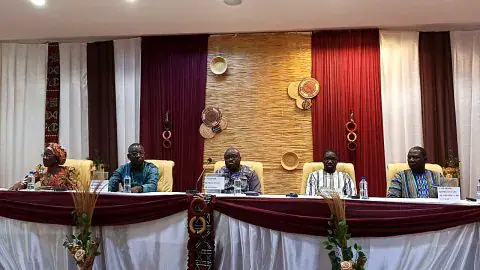
The third edition of the National Land Security Days (JNAF) was launched in Ouagadougou, Burkina Faso, on November 24, 2026. The event, organized by the National Multi-Actor Platform on Land (PMAF), brings together around 100 institutional actors, peasant organizations, civil society groups, technical and financial partners, and community representatives. The theme of this year's discussions is "Land tenure security: agrarian reforms and socio-territorial tensions in Burkina Faso."
Land security remains a significant challenge for Burkina Faso, with issues such as land conflicts, limited access to land for women and young people, pressure on natural resources, and population displacement. The country's governance of land raises concerns that go beyond rural areas. Laurent Domboué, president of the Peasant Confederation of Faso (CPF) and representative of the PMAF, emphasized that land security is crucial for producers to invest and contribute to food sovereignty.
The discussions will focus on the implications of the new law on Agrarian and Land Reorganization (RAF) and mechanisms to promote more peaceful management of land resources. Participants will also examine the challenges faced by populations in accessing land, particularly women and young people. The law, adopted on October 21, 2025, aims to reorganize the national land domain, but its implementation raises questions about the security of existing rights and the recognition of local rights.
Blaise Yoda, director general of land, training, and rural organization, representing the minister of agriculture, highlighted the strategic importance of land for the country's development. He stressed that the new reform reflects the state's commitment to strengthening its role in organizing and regulating the national land domain. However, he noted that the main challenge is translating the legal provisions into concrete realities for the populations.
The event also heard from partners, including Welt Hunger Hilfe (WHH) and the International Fund for Agricultural Development (FIDA). Azara Remalia Nfon Dibie Sanogo, country director of WHH, emphasized that land tenure security is essential for fighting hunger and improving living conditions. She noted that uncertainty about land rights can discourage producers from investing in their farms.
Noël Koutéra Bataka, country director of FIDA, highlighted the link between land security and agricultural investments. He stressed that it is difficult to encourage producers to invest sustainably in their farms when they do not have secure land rights. The discussions will culminate in a roadmap with recommendations for authorities to improve land governance and security.
The participants will also conduct field visits to Ziniaré and Boussouma to learn about experiences in managing polyvalent centers and the realities of internally displaced persons and host communities. The event aims to promote a better understanding of land issues and to identify concrete solutions to the challenges faced by the populations.
Key points
- The new law on Agrarian and Land Reorganization aims to reorganize the national land domain.
- Land security is crucial for producers to invest and contribute to food sovereignty.
- The discussions will focus on the implications of the new law and mechanisms to promote more peaceful management of land resources.