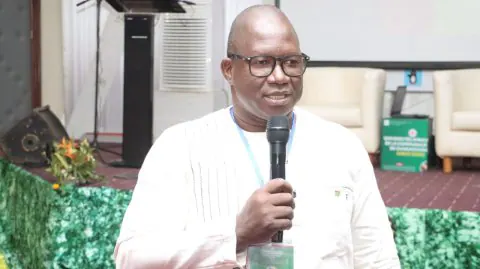
The 15th edition of the African Universities of Communication in Ouagadougou (UACO) featured a presentation by Paul Ismaël Bicaba, an instructor and researcher at the Institute of Information and Communication Sciences (ISTIC). On October 8, 2026, Bicaba discussed "Afro-Descendants as a Lever for Constructing Burkina Faso's International Narrative: Challenges, Strategies, and Perspectives." His presentation highlighted the evolving nature of international diplomacy, where mastering national narratives has become crucial.
Bicaba emphasized that influence in the international arena no longer relies solely on military or economic capabilities but also on the ability to create positive, credible, and attractive representations before international public opinion. He noted the emergence of new actors in public diplomacy, including diasporas, transnational communities, digital networks, and Afro-descendants. These groups have become increasingly strategic in shaping a nation's international image.
The research, conducted using a qualitative approach with documentary and comparative analysis, drew on strategic communication, public diplomacy, soft power, nation branding, and postcolonial studies. Bicaba aimed to examine how Afro-descendants can contribute to Burkina Faso's international repositioning. His study analyzed the theoretical foundations of strategic communication and identified resources that could support a renewed international narrative for Burkina Faso.
The study found that Afro-descendants are a strategic resource that has not been sufficiently exploited in African international communication policies. Bicaba argued that they can act as relays of influence, producers of narratives, cultural mediators, and informal ambassadors. This offers Burkina Faso an opportunity to develop a more inclusive, participatory, and resilient public diplomacy.
Bicaba's research proposed a conceptual model for mobilizing Afro-descendants, known as the AIN-C model (Afro-descendants-Influence – Narrative – Credibility). This model considers Afro-descendants as strategic actors in international communication, capable of producing, amplifying, legitimizing, and diffusing national narratives. The AIN-C model explains how Afro-descendants participate in producing the international narrative of a country.
According to Bicaba, Burkina Faso has significant assets that could feed a renewed international narrative, including its history of pan-African ideals and rich cultural heritage. However, this symbolic capital remains largely overlooked in contemporary international representations. The study suggests that integrating Afro-descendants into a coherent communication and cooperation strategy could be an effective way to enhance Burkina Faso's international visibility.
The presentation at UACO highlighted the potential for Afro-descendants to play a pivotal role in constructing a positive international image for Burkina Faso. By leveraging the resources and capacities of Afro-descendants, the country can develop a more robust and inclusive diplomacy. The AIN-C model provides a framework for understanding and harnessing this potential.
Key points
- Paul Ismaël Bicaba presented a model for leveraging Afro-descendants to enhance Burkina Faso's international narrative.
- The study proposed the AIN-C model as a framework for integrating Afro-descendants into international communication strategies.
- Afro-descendants can act as strategic actors in producing and amplifying national narratives, contributing to a country's international influence.