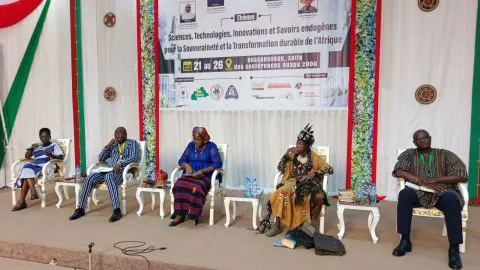
In Burkina Faso, a panel discussion on "Endogenous Knowledge and Scientific Research" was held on September 25, 2026, in Ouagadougou, as part of the 6th edition of the International Symposium on Science and Technology. The event brought together researchers, institutional leaders, and holders of endogenous knowledge to explore ways to improve the transmission, documentation, and valorization of these inherited knowledge systems. The goal is to foster a closer dialogue between endogenous knowledge, scientific research, and modernity.
The panel featured several notable experts, including Konomba Traoré, a living human treasure, Dr. Ludovic Kibora, a research director in anthropology at the Institute of Social Sciences, Dr. Sylvie Zongo, director of endogenous knowledge at the Ministry of Higher Education, and Dr. Sylvin Ouédraogo, a research director in pharmacology at the Institute of Research in Health Sciences. The discussion highlighted the importance of preserving and transmitting endogenous knowledge, which is often at risk of disappearing with the passing of its holders.
According to Dr. Sylvie Zongo, transmission is a fundamental characteristic of endogenous knowledge, and her ministry is working on an orientation document to guide the preservation and transmission of these knowledge systems. The document aims to define mechanisms, strategies, and a roadmap for the gradual involvement of various stakeholders, including the education sector. Dr. Zongo emphasized that the approach should be inter-ministerial and inclusive of different levels of education.
Dr. Ludovic Kibora stressed the significance of documenting endogenous knowledge to prevent its disappearance. He noted that while these knowledge systems are already shared within families and communities, systematic documentation would help to better understand, valorize, and give visibility to the people who hold them. This approach can also contribute to a form of decolonization of knowledge, giving more importance to the knowledge produced, conserved, and transmitted by societies themselves.
The dialogue between endogenous knowledge and scientific research is particularly relevant in the field of health. Dr. Sylvin Ouédraogo emphasized the need to better prepare health professionals to engage with traditional medical knowledge holders. This exchange can help to promote a more comprehensive understanding of health and improve the delivery of healthcare services.
The experts also highlighted the importance of considering the diversity of endogenous knowledge and the need to respect the communities and individuals who hold these knowledge systems. Dr. Kibora noted that some practices and knowledge are already being documented and transmitted to younger generations, but more needs to be done to preserve these cultural heritage systems.
The participants agreed that the preservation and valorization of endogenous knowledge require a collaborative effort from various stakeholders, including researchers, institutional leaders, and holders of endogenous knowledge. The goal is to create a living heritage that can respond to contemporary realities and challenges. Key initiatives are expected to be implemented by 2027-2028 to support the preservation and transmission of endogenous knowledge in Burkina Faso.
Key points
- Experts emphasize the need for systematic documentation and transmission of endogenous knowledge to prevent its disappearance.
- The preservation of endogenous knowledge requires a collaborative effort from various stakeholders, including researchers, institutional leaders, and holders of endogenous knowledge.
- The dialogue between endogenous knowledge and scientific research can contribute to a more comprehensive understanding of various fields, including health and environmental management.