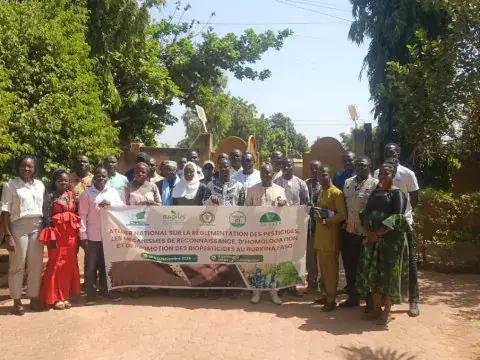
An ongoing national workshop in Koudougou, Burkina Faso, aims to enhance understanding of the country's pesticide control law and explore ways to promote the recognition and regulation of biopesticides. The event, which runs from November 10 to 11, 2026, brings together representatives from public institutions, research organizations, private sector entities, farmers' associations, and civil society groups. Organized by the National Council for Organic Agriculture (Cnabio) in partnership with the RADIUS project, the workshop seeks to strengthen the appropriation of the law and its implementing texts.
The law in question, n° 026-2017/AN, regulates pesticide control in Burkina Faso. Participants will review the law and its application texts, assess the current state of biopesticide use, production, and distribution in the country, and examine best practices from other sub-regional countries. This analysis aims to identify effective approaches that Burkina Faso can adopt. The ultimate goal is to develop a multi-stakeholder roadmap and draft a policy note to support advocacy for biopesticides. This effort has been long-awaited by agroecology stakeholders, who have been advocating for recognition of their products for over 15 years.
Seydou Savadogo, vice-president of Cnabio and president of the Cooperative of Manufacturers, Suppliers of Inputs, and Agroecological Equipment, views the workshop as a significant milestone in the campaign for biopesticide recognition. He emphasizes that collaboration between producers, researchers, and authorities is crucial to defining usage conditions and ensuring the safety of these products for human health and the environment. The recognition of biopesticides, also known as bioprotectors, is seen as essential for valorizing local know-how and solutions derived from natural resources.
Antoine Sanon, coordinator of the RADIUS project, stresses that the transition to agroecology requires not only the production of knowledge and technological innovations but also a favorable institutional and regulatory environment. He notes that Burkina Faso has significant potential for biopesticide development but highlights the need to demonstrate their efficacy, guarantee their quality and safety, and facilitate their regulatory recognition. The project's goal is to bring together research, producers, and public decision-makers to support this dynamic.
Clovis Nabié, representing the director general of plant productions, underscores the importance of protecting crops for food sovereignty, as pests and diseases cause significant crop losses annually. While biopesticides offer a promising alternative, he acknowledges that current approval procedures are primarily designed for synthetic chemical products and may not be adapted to the characteristics of biological products developed by local researchers and actors.
The development of biopesticides in Burkina Faso is considered a vital area of research, with various institutions, universities, and civil society organizations already working on solutions based on local resources, such as botanical extracts like neem. These products are seen as an attractive alternative, as they can reduce risks for users and the environment while promoting local job creation and value addition.
The stakeholders involved in biopesticide production and promotion hope to make these solutions recognized and accessible to farmers, contributing to a healthier agriculture sector. The ongoing workshop provides a platform for discussions on adapting regulatory procedures to the specificities of biopesticides while ensuring their efficacy and quality. The goal is to establish proportionate and rigorous procedures that take into account the unique characteristics of biological products.
Key points
- The national workshop aims to develop a roadmap for promoting the recognition and regulation of biopesticides in Burkina Faso.
- Stakeholders emphasize the need for collaboration between producers, researchers, and authorities to define usage conditions and ensure the safety of biopesticides.
- The recognition of biopesticides is seen as crucial for valorizing local know-how and promoting a healthier agriculture sector in Burkina Faso.