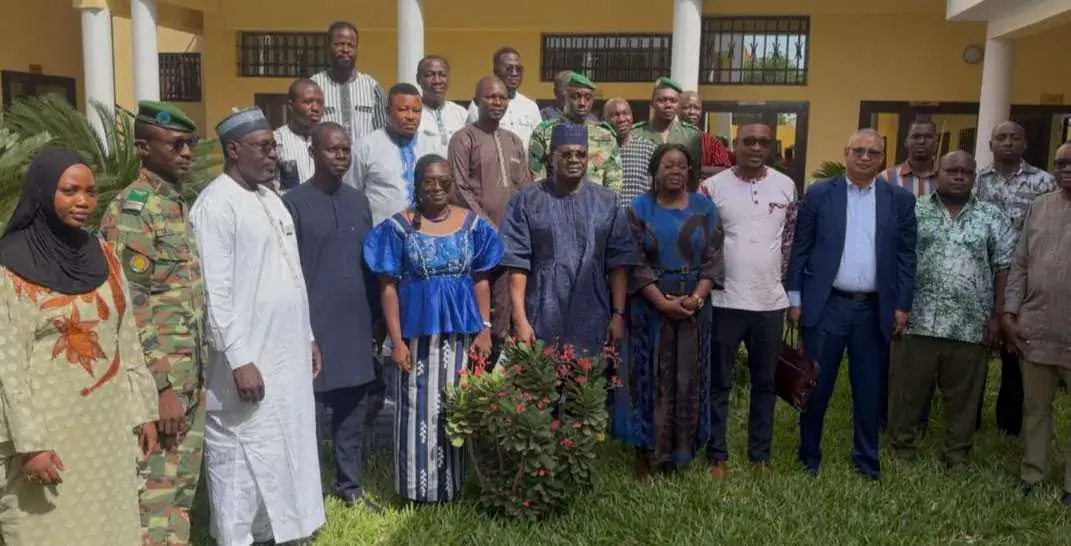
The Government of Burkina Faso is taking steps to implement its National Climate Security Strategy (SNSC-BF 2025-2029). On October 28, 2026, stakeholders from the security and environmental sectors gathered in Ouagadougou for a workshop organized by the Centre national d'études stratégiques du Burkina Faso (CNES-BF) and the Institute for Security Studies (ISS). The goal is to translate strategic orientations into concrete actions to address the effects of climate change on peace and security.
The Sahel region, where Burkina Faso is located, is experiencing rising temperatures at an alarming rate. According to data, the region recorded a 0.6 to 0.8 °C increase in temperature between 1970 and 2010. This change exacerbates land degradation, reduces water resources, and threatens the livelihoods of local populations. The country's climate security strategy aims to address these challenges.
General Aimé Barthélemy Simporé, director-general of CNES-BF, emphasized that climate change is not a direct cause of conflicts but interacts with pre-existing vulnerabilities such as competition for natural resources and fragile conflict regulation mechanisms. This approach highlights the need to consider economic, social, institutional, and environmental factors that can transform pressure on natural resources into security tensions.
The workshop aims to move beyond the adoption of texts and examine the conditions for their implementation. Participants seek to strengthen common understanding of the links between climate, peace, and security in Burkina Faso, assess initial actions, and identify achievements, challenges, and priority needs. They also aim to share effective initiatives and experiences that can be replicated in other areas.
The strategy also focuses on improving coordination among concerned actors and providing a response adapted to community realities. Cooperation between Burkina Faso, Mali, and Niger is another key aspect of this dynamic. Sharing experiences and strategies could enhance common responses to climate and security challenges in the Sahel region.
Fahiraman Rodrigue Koné from ISS emphasized the institution's commitment to supporting African leadership on governance and stability issues. By articulating environmental policies, conflict prevention, and security actions, Burkina Faso aims to make its national strategy an operational instrument for population resilience and peace consolidation.
The implementation of the National Climate Security Strategy is crucial for Burkina Faso, given the country's vulnerability to climate change impacts. The strategy is expected to enhance the country's ability to address climate-related security challenges and promote sustainable development. Key stakeholders will continue to engage in discussions to ensure effective implementation of the strategy.
Key points
- The Government of Burkina Faso has convened stakeholders to implement its National Climate Security Strategy.
- The Sahel region is experiencing rising temperatures, with a 0.6 to 0.8 °C increase recorded between 1970 and 2010.
- The strategy aims to address climate-related security challenges and promote sustainable development in Burkina Faso.