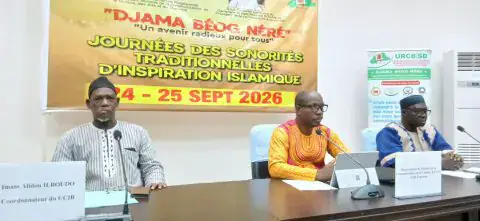
The Centre Culturel Islamique du Burkina Faso (CCIB) has launched a two-day event, "Journées des Sonorisations Traditionnelles d'Inspiration Islamique," in Ouagadougou, Burkina Faso. The event, which started on September 24, 2026, aims to explore the significance of traditional Islamic sounds in promoting social cohesion and unity. The initiative is part of the project's Djama Beog Néré, which seeks to revive and promote cultural practices that have long been a platform for social interaction among different segments of Burkinabè society.
The event was opened by Abdoulaye Dioni, technical advisor to the Minister of Communication, Culture, Arts, and Tourism, who emphasized the importance of these traditional sounds in the current context of Burkina Faso. According to him, the reconquest of the national territory inevitably involves the reconquest of collective identity and values. These chants and rhythms, he added, are not obsolete but rather essential tools for building peace.
Imam Alidou Ilboudo, national coordinator of the CCIB, explained that the event aims to assess how traditional Islamic sounds can contribute to rebuilding social cohesion, peace, and national unity. The discussions will also focus on the relationship between artistic expressions and Islamic doctrine, with the goal of debating with Muslim scholars on the doctrinal contours of music and singing.
The event also seeks to address the challenges faced by young Muslim artists who want to express themselves through music while adhering to their faith. Imam Ilboudo noted that there is a need to find a balance between artistic expression and the requirements of faith. This reflection is part of a broader dynamic of cultural reappropriation, according to participants.
Moussa Bambara, executive director of the Union of Religious and Traditional Leaders of Burkina Faso for Health and Development, highlighted the reciprocal influence between African cultures and Abrahamic religions. He noted that Islam has influenced African cultures, just as African cultures have influenced Islam.
The two-day event will feature discussions, debates, and performances aimed at identifying ways to preserve and promote traditional Islamic sounds. The organizers hope to make culture a space for dialogue, cohesion, and peace. The event is expected to bring together various stakeholders, including artists, scholars, and community leaders.
The revitalization of traditional Islamic sounds is seen as a way to offer young people a sense of identity and belonging in the face of hate speech and division. The event's outcome is expected to contribute to the ongoing efforts to promote social cohesion and unity in Burkina Faso.
Key points
- The CCIB event aims to promote traditional Islamic sounds as a means of fostering social cohesion and unity in Burkina Faso.
- The event seeks to address the challenges faced by young Muslim artists who want to express themselves through music while adhering to their faith.
- The revitalization of traditional Islamic sounds is seen as a way to offer young people a sense of identity and belonging.