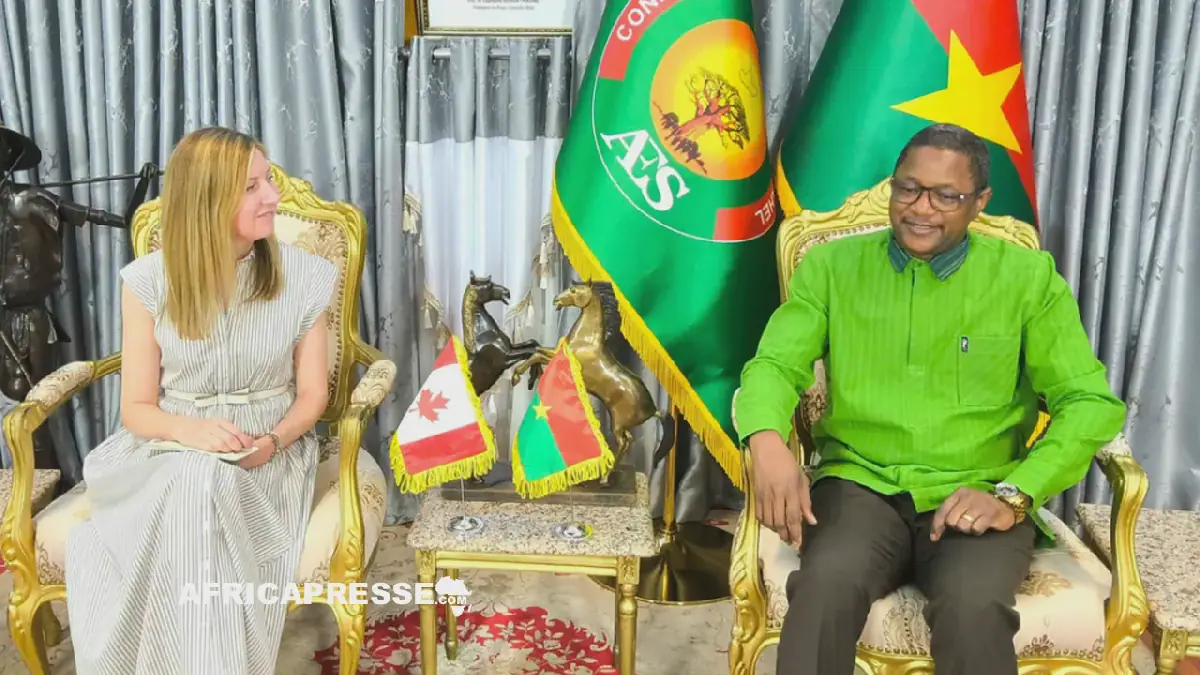
Burkina Faso and Canada have opened the way to a re-examination of their cooperation, with a focus on building relationships based on reciprocity, diversification of partnerships, and respect for state sovereignty. The Burkinabé Minister of Foreign Affairs, Karamoko Jean Marie Traoré, received Canadian Deputy Minister for Africa Cheryl Urban in Ouagadougou on November 23, 2026. They expressed their desire to move beyond traditional aid schemes and build stronger bilateral ties in areas such as health, mining, and economy.
The meeting between Traoré and Urban discussed the prospects of strengthening bilateral ties established over 60 years. According to a statement from the Burkinabé Ministry of Foreign Affairs, Urban presented Canada's new approach to its partners, particularly in Africa, which emphasizes diversification of exchanges, search for mutually beneficial interests, and respect for sovereignty. Urban's visit aimed to gather the priorities of the Burkinabé authorities to adapt cooperation to the country's realities.
This visit is part of a context of redefinition of cooperation relations between Ouagadougou and its international partners. Since the arrival of Captain Ibrahim Traoré in power in September 2022, Burkina Faso has distanced itself from France and several Western institutions while getting closer to Russia and consolidating the Sahel States Confederation (AES) with Mali and Niger. In March 2025, Ouagadougou announced the withdrawal of its troops from the joint force of the G5 Sahel and then formalized its departure from the International Organization of La Francophonie.
The visit of Cheryl Urban reflects Canada's desire to maintain a channel of dialogue with a strategic partner in the Sahel, despite regional turmoil. The two parties are discussing a renewed partnership, but the concrete outlines remain to be defined. No calendar, amount, or specific project was announced at the end of the meeting. However, Urban's visit could lead to a reprogramming of Canadian aid, historically concentrated on health, education, and governance.
For Ouagadougou, the challenge is to convert this opening into investments in mining and economy, priority sectors. For Ottawa, it is a question of preserving a presence in a region where Western partners have gradually withdrawn, without endorsing the political choices of the Burkinabé authorities. The promised rebalancing must therefore translate into acts to avoid remaining a communication exercise.
The exchanges also dealt with the Sahel States Confederation, of which Burkina Faso is a member with Mali and Niger. Minister Traoré presented to his interlocutor the prospects of consolidation of this organization, which intends to strengthen its presence on the regional and international scenes. This sequence illustrates the Burkinabé strategy: reassuring its partners on the viability of the AES while negotiating bilaterally with Western powers.
The Burkinabé Minister of Foreign Affairs welcomed a démarche allowing for a better understanding of the realities on the ground. He affirmed that this new Canadian orientation was in line with the changes made in Burkina Faso's cooperation policy. Ouagadougou aims to move out of the traditional logic between donors and beneficiaries, considered susceptible to maintaining frustrations, to prioritize the valorization of endogenous capacities and economic growth.
Key points
- The new Canadian approach emphasizes diversification of exchanges, search for mutually beneficial interests, and respect for sovereignty.