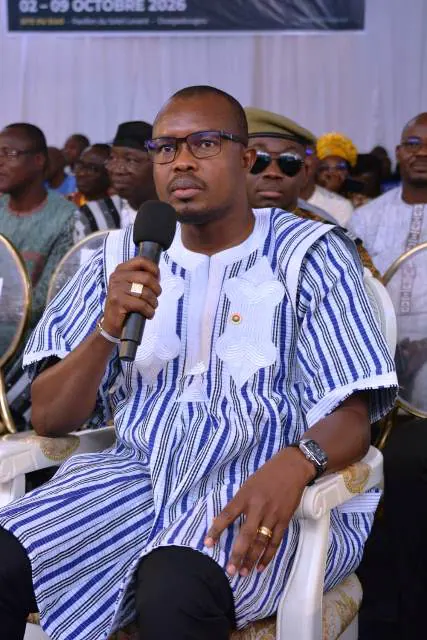
The Burkinabé government has taken steps to address the country's food security challenges, with a focus on increasing domestic production and reducing dependence on imports. A high-level panel discussion was held in Ouagadougou on October 6, 2026, to explore ways to boost agricultural production and promote national sovereignty. The panel, moderated by Minister of State for Territorial Administration and Mobility Émile Zerbo, brought together key government officials, including Prime Minister Rimtalba Jean Emmanuel Ouédraogo and Minister of State for Agriculture Ismaël Sombié.
According to Minister Sombié, Burkina Faso faced significant food security challenges in 2022, with 19.8% of the population affected by food insecurity. The country spent an estimated 85.9 billion F CFA annually on rice imports and 62 billion F CFA on wheat and its derivatives. However, the government has made progress in recent years, with cereal production exceeding 7 million tons in 2025, a significant increase from previous years. This has enabled the country to achieve a cereal coverage rate of 124.6%.
The government's efforts to boost agricultural production have been driven by a desire to address the country's paradoxical situation, where it has significant natural resources but remains heavily dependent on imports. Minister Sombié highlighted the country's potential for agricultural development, with 9 million hectares of arable land, 233,500 hectares of irrigable land, and 500,000 hectares of low-lying areas that can be developed. The government has prioritized the development of these areas to increase food production and reduce reliance on imports.
The government's "Offensive Agro-Pastorale" initiative has been instrumental in driving agricultural development in the country. The initiative has led to significant increases in rice and maize production, with rice production reaching 1,537,000 tons in 2025, up from 426,000 tons in 2022. Maize production has also increased, reaching 2,600,000 tons, exceeding initial targets. The government aims to continue to build on this progress, with a focus on developing irrigation systems to secure crops against climate-related risks.
Prime Minister Ouédraogo has praised Minister Sombié for his efforts in driving agricultural development and has emphasized the need for the country to prioritize quality and excellence in its agricultural production. He has warned that in times of crisis, countries will prioritize their own food needs, and Burkina Faso may struggle to import food even if it has the financial resources to do so. The Prime Minister has called on all stakeholders in the agricultural value chain to prioritize quality and aesthetics in their production and processing of food products.
The government's focus on promoting national sovereignty through food production has been driven by a desire to reduce the country's reliance on imports and promote self-sufficiency. The Minister of State for Agriculture has emphasized the need for the country to develop its agricultural sector to ensure that it can feed its population without relying on imports. The government has set ambitious targets for the development of the agricultural sector, including increasing milk production to 10,000 liters per day.
The Burkinabé government's efforts to boost agricultural production and promote national sovereignty are seen as critical to addressing the country's food security challenges. The country's progress in increasing food production has been significant, but there is still much work to be done to ensure that the country can meet its food needs without relying on imports. The government's commitment to prioritizing quality and excellence in agricultural production is seen as a key step in achieving this goal.
Key points
- The Burkinabé government aims to reduce its dependence on food imports and promote national sovereignty through increased domestic food production.