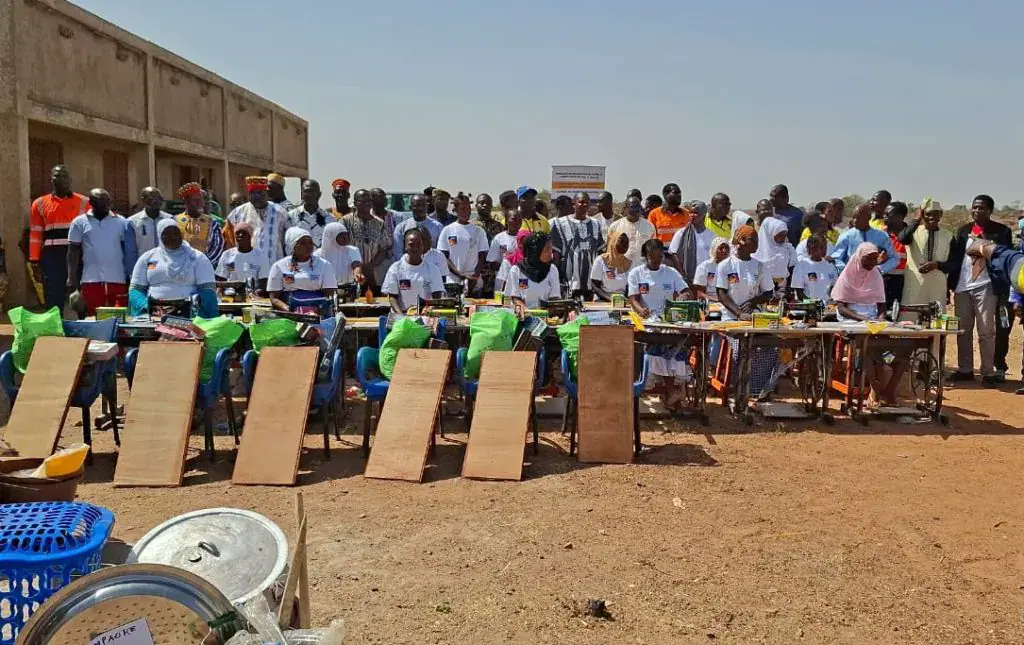
A ceremony was held on November 29, 2026, at the CFPEM-SST training center in Niaogho, Burkina Faso, to mark the end of the second cohort of the Livelihood Restoration Program (PRMS) initiated by mining company Kiaka SA. The program aimed to equip young people from the communes of Niaogho, Gogo, Garango, Boussouma, and Béguedo with skills in various trades.
The program, which started on September 12, 2026, in Gogo, lasted for three months and covered theoretical and practical courses in trades such as food processing, catering, poultry farming, fish farming, sheep and cattle fattening, hairdressing, sewing, building electricity, two-wheel mechanics, mobile phone repair, welding, and plumbing.
In addition to these technical skills, participants also received training in transversal modules, including entrepreneurship, financial education, microenterprise management, and commercial marketing. Upon completion of the program, the trainees received certificates and installation kits to help them start their own businesses.
Evariste Gamdéma, representing the management of Kiaka SA, emphasized that the program's objective is to support the development of mining projects while enabling affected populations to strengthen their capacities, diversify their sources of income, and build new economic perspectives. He encouraged the women in the program to value their skills.
Bara Mohamed, representing the trainees, thanked the organizers for their support and reminded the participants of their responsibilities. He urged them to put their skills into practice, take care of their equipment, manage their resources well, and persevere in the face of difficulties.
Ibrahim Ouédraogo, representing the CEO of the CFPEM-SST center, explained the pedagogical approach used, which is based on technical fundamentals, hygiene and safety rules, and real-life situations. He advised the trainees to focus on quality to sustain their activities and to be convinced that a well-mastered trade can be a sustainable source of income and dignity.
The ceremony was presided over by Constantin Dabiré, the high commissioner of the Boulgou province, who emphasized the importance of shared responsibility in local development and the proper use of the material provided. He reminded the trainees that the certificates and installation kits they received should be seen as tools to help them transition from learning to practice.
Key points
- The program aims to support households affected by mining activities and promote self-employment and income-generating activities.
- The trainees received certificates and installation kits to help them start their own businesses.
- The program is part of Kiaka SA's efforts to contribute to the sustainable development of local communities.