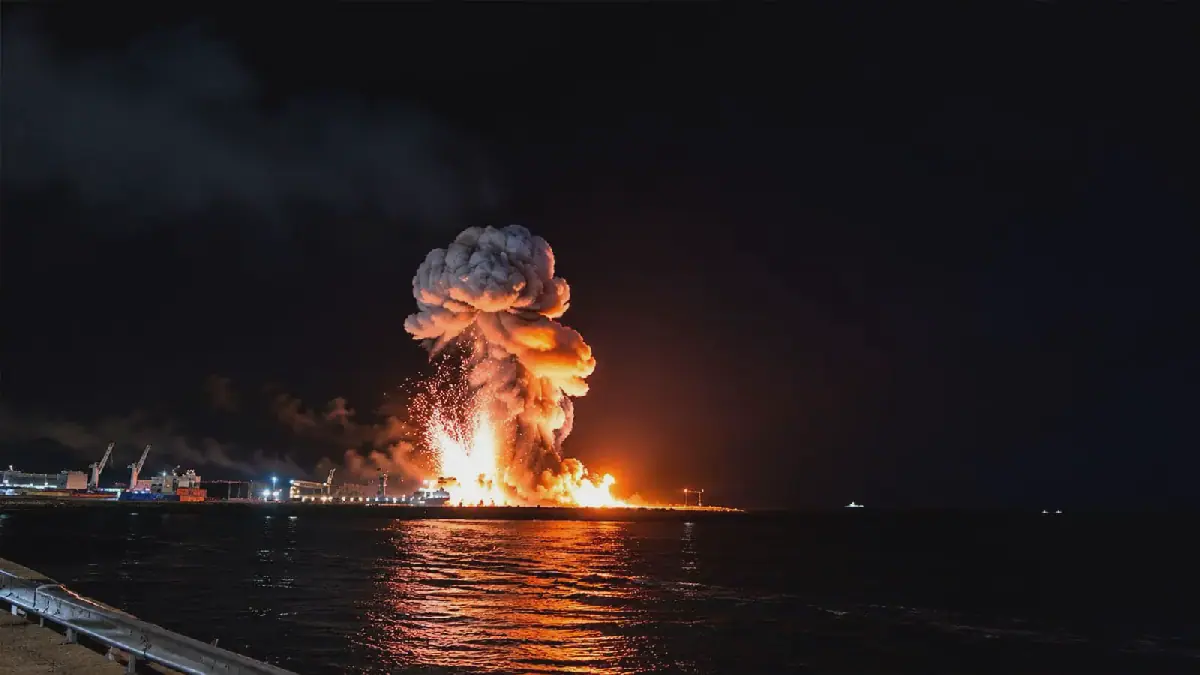
The Telegraph, a British newspaper, has reported that the recent explosions at the port of Benghazi on November 22 signify the expanding geographical scope of the Russian-Ukrainian war. According to Roland Oliphant, the newspaper's senior foreign correspondent, the attacks demonstrate that the conflict, although not yet a global war, is being fought across an increasingly wide geographic area.
The analysis published in The Telegraph notes that the targeting of Russian ships off the coast of Libya has extended the maritime theater of operations to the Mediterranean Sea, following attacks on ships in the Black Sea and the Baltic Sea. Furthermore, the conflict has also spread to land and air domains, with reported sabotage operations targeting British and European targets, as well as incidents involving Russian missiles in Poland on Friday.
The Black Sea has become, in Oliphant's assessment, the most dangerous maritime passage in the world due to the targeting of supply lines and trade associated with the war. He reports that at least nine cargo ships and tankers were attacked in October, resulting in the deaths or disappearances of at least 30 sailors, as well as the sinking of two ships off the coast of Bulgaria the previous week.
The Telegraph's report provides details on two ships that were attacked: the Somali-flagged "Bitoil 8", which was carrying 3,000 tons of wheat from Romania to Egypt and capsized after being struck by two unmanned boats, and the Liberian-flagged gas tanker "Gas Hasky", which was transporting propane from Alexandria to Romania and sank after being hit by drones. All crew members on both vessels were reportedly rescued.
According to The Telegraph, the maritime confrontation extended to the Baltic Sea on Saturday, when the Russian cargo ship "Sparta 2" was attacked by drones while sailing in the Gulf of Finland. Although Ukraine has not claimed responsibility for the attack, which occurred in Finnish territorial waters, the incident highlights the expanding scope of the conflict.
The report also touches on the attacks off Benghazi, with Ukraine claiming that seven unmanned naval drones were used to target the Russian warship "Merkuriy" and the cargo ship "Angara". These drones allegedly launched from a mother ship, possibly a cargo vessel capable of operating in international waters. However, not all parties have accepted this account, with the Albanian government denying rumors of providing a base for the operation.
The analysis concludes that the Russian-Ukrainian war, while not yet a global conflict, is likely to continue in multiple theaters around the world as the maritime confrontation expands and the parties involved demonstrate their ability to conduct operations far from the direct conflict zones.
Key points
- The conflict's expansion to new geographic areas, including the Mediterranean Sea and the Baltic Sea.
- The increasing involvement of new actors and regions in the conflict.
- The potential for further escalation and spread of the conflict to other parts of the world.
Reporting sources
- تلغراف: هجمات بنغازي تكشف اتساع الحرب الروسية الأوكرانية · Libya Al Ahrar TV