British documentary filmmaker Andy Mundy-Castle has turned his lens on South Africa's protest legacy in his latest documentary, Shoot the People. The film, which follows photographer and activist Misan Harriman as he documents global campaigns for social change, captures the country's intergenerational spirit of activism. Mundy-Castle believes that South Africa is a unique example of how protest can lead to social change.
Mundy-Castle's connection to South Africa dates back to his childhood, where he frequently visited the country and developed an awareness of its social and political fabric. A particular memory that has stuck with him is from his time living in Hout Bay, where a single highway serves as a class division. This experience has had a lasting impact on Mundy-Castle, who sees documentary work as an act of custodianship, particularly when it comes to sensitive topics like human rights and social justice.
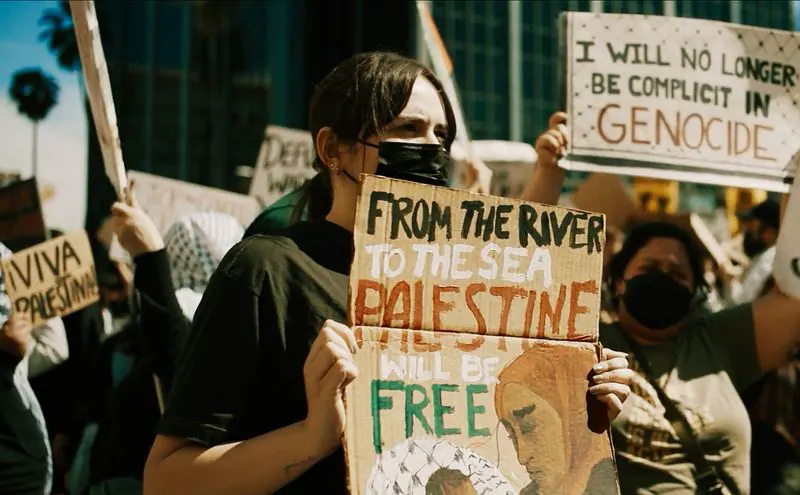
The South African chapter of Shoot the People focuses on two protests: a pro-Palestine march at the University of Johannesburg and a demand for reparations for apartheid-era crimes led by senior citizens on the steps of the Constitutional Court in Braamfontein. These events embody the deep-rooted culture of protest in South Africa, which Mundy-Castle believes is unique in the world. He notes that the country's history of protest has been passed down through generations, with older activists inspiring younger ones to continue the fight for social change.
Mundy-Castle was struck by the resilience of the older activists outside the Constitutional Court, who embodied the culture of dance and song within protest. He sees the student activists at the University of Johannesburg as the direct descendants of this community, who are still showing up to protest. This sense of lineage runs through the film, which ends with words from anti-apartheid photographer Peter Magubane, one of Harriman's inspirations.
Magubane's words emphasize the importance of documenting struggles for social change, so that future generations understand the sacrifices made to achieve their rights and privileges. Mundy-Castle believes that the film itself is part of this passing of the torch, with archival footage woven throughout serving as a handover from generation to generation. By sharing these stories, Mundy-Castle hopes to inspire others to lend their voices to those who are less fortunate.
The film has already had a positive impact on its audience, with some viewers feeling activated to help others after seeing the film. Mundy-Castle believes that this is a powerful act of kindness and love, and that the film serves as a reminder that individuals are not alone in their search for social change. He hopes that the film will continue to inspire others to join the fight for a more just and equitable society.
Shoot the People will air on Al Jazeera on 30 September, offering viewers a unique perspective on the power of protest to bring about social change. Through his documentary, Mundy-Castle aims to shine a light on the people and stories at the core of these movements, and to inspire others to join the fight for a better world.
Key points
- The documentary Shoot the People examines global protest movements, including those in South Africa, as a force for social change.
- South Africa's unique history of protest has been passed down through generations, with older activists inspiring younger ones to continue the fight for social change.
- The film aims to inspire others to lend their voices to those who are less fortunate and to join the fight for a more just and equitable society.