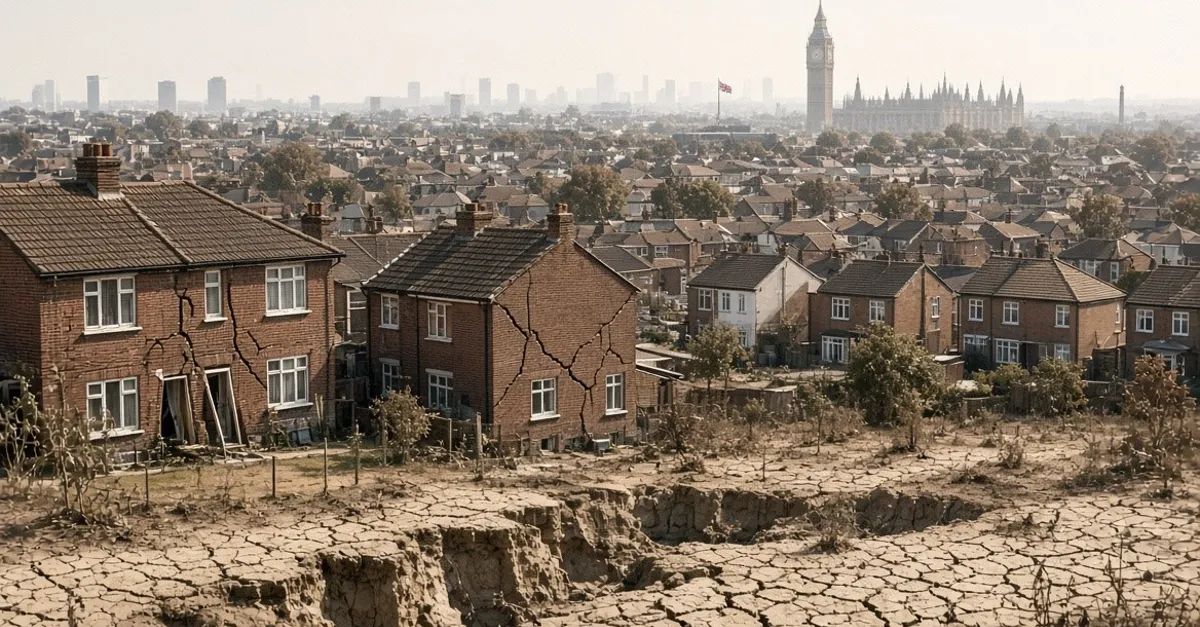
Britain is experiencing a silent crisis, with the country's soil turning into a threat to its built infrastructure. The UK is facing rising insurance claims and declining investor confidence in the real estate market. According to data from the Association of British Insurers (ABI), insurance claims related to soil movement and foundation damage reached £297 million in 2025, a 90% increase in just four years.
The issue is particularly concerning, with the second quarter of the year seeing a record average compensation of £20,000 per household, a 15% increase from the same period in 2025. This suggests that soil movement damage is becoming more severe and costly. The problem is not evenly distributed across the country, with southeast England, particularly London and its suburbs, being the most affected.
The area's soil, known as "London clay," is prone to shrinking and swelling with changes in moisture levels, causing foundations to shift and resulting in cracked walls and stuck doors. In severe cases, this can lead to partial building collapses. Cherie Chan, a partner at Deloitte, describes this situation as a "major challenge for British property insurers," highlighting the complexity and far-reaching consequences of the issue.
Insurers are facing a double pressure, with an increasing frequency of incidents and rising costs per claim. The cost of repairing foundations and structural damage is substantial, and Deloitte predicts that the home insurance sector will experience losses in 2026. This may lead to higher premiums, revised risk assessment models, and a re-evaluation of the areas and properties that insurers are willing to cover.
The long-term outlook is concerning, with the British Geological Survey (BGS) estimating that up to 4.2 million homes, or 11% of the country's total housing stock, may be at risk by 2070. This is due to recurring droughts and soil re-wetting cycles. The BGS warns that the consequences of this risk will not be limited to the insurance sector, but will also impact property prices and put significant financial burdens on the state and individuals.
The issue is expected to have far-reaching consequences, with the potential to affect not only homeowners but also the broader economy. As the situation continues to unfold, it is likely that the UK government and insurance industry will need to take steps to mitigate the risks and address the challenges posed by climate change.
The UK's climate change risks are becoming increasingly apparent, with the country's homes and infrastructure facing significant threats. The government's and insurers' responses to these challenges will be crucial in determining the country's resilience to the impacts of climate change.
Key points
- The UK is facing a growing crisis, with climate change causing significant damage to homes and foundations, and insurers struggling to keep up with the rising costs.
- The issue is expected to have far-reaching consequences, with up to 4.2 million homes at risk by 2070.
- Insurers are facing a double pressure, with an increasing frequency of incidents and rising costs per claim.