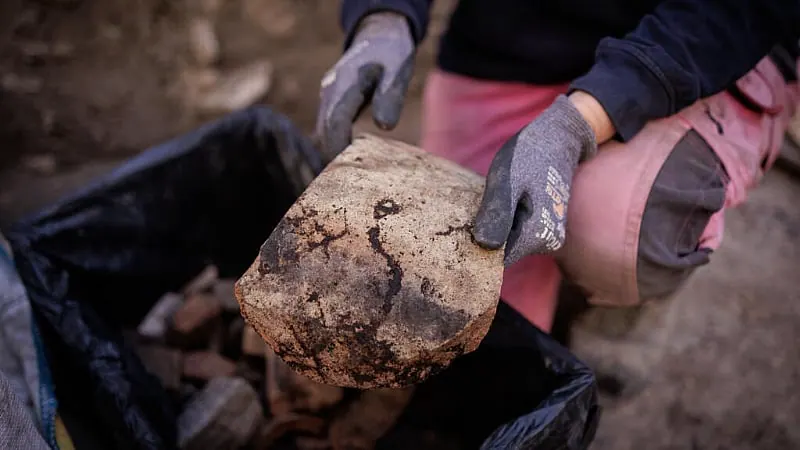
A significant archeological discovery has been made in Paris, potentially confirming the location of the city's original settlement. An ancient wall dating back to the Gallo-Roman period was found beneath a hospital on the Ile de la Cité, near Notre-Dame Cathedral. The 20-meter stone-and-wood wall is believed to be a fragment of the ramparts of Lutetia, built by the Gallic Parisii tribe.
The Ile de la Cité has traditionally been regarded as the center of Lutetia, but a rival theory suggests it may have been located in Nanterre, a suburb to the west. Culture Minister Catherine Pegard described the find as a "major breakthrough" and a potentially crucial discovery for understanding Gallic Lutetia. The ministry is cautious, however, and further verification of the wall's function and chronology is required.
The wall was uncovered during excavations beneath the Hotel-Dieu hospital and bears traces of fire, which may correspond to Julius Caesar's account of the Gauls setting fire to their town before the Battle of Lutetia against the Romans. According to Caesar's "Gallic Wars," Lutetia was located on an island in the river Seine, but its exact location has been debated.
Carbon dating technology has estimated the charred evidence to date from 10-200 BC, which includes the Battle of Lutetia in 52 BC. Elodie Perugini, an archeologist with the city of Paris, was present during the excavations, which have shed new light on the city's ancient past. The discovery has generated significant interest among historians and archeologists.
The Ile de la Cité, home to Notre-Dame Cathedral, is the largest island in the river Seine and became the center of the Roman settlement of Lutetia. The island's strategic location has made it a crucial site for understanding the city's development. The archeological find has provided new insights into the city's ancient history.
The French culture ministry has described the discovery as a "remarkable" convergence of evidence, which may help to confirm the location of Lutetia. While further research is needed, the find has the potential to significantly impact our understanding of the city's origins.
The discovery of the ancient wall is a significant addition to the ongoing archaeological dig at Notre-Dame, which has unearthed 2,000 years of history. The excavation has provided a unique opportunity for researchers to study the city's evolution over time.
Key points
- The ancient wall discovered beneath Paris may confirm the location of the city's original settlement.
- The wall, dating back to the Gallo-Roman period, is believed to be a fragment of the ramparts of Lutetia.
- The discovery has generated significant interest among historians and archeologists, with further research needed to confirm its significance.