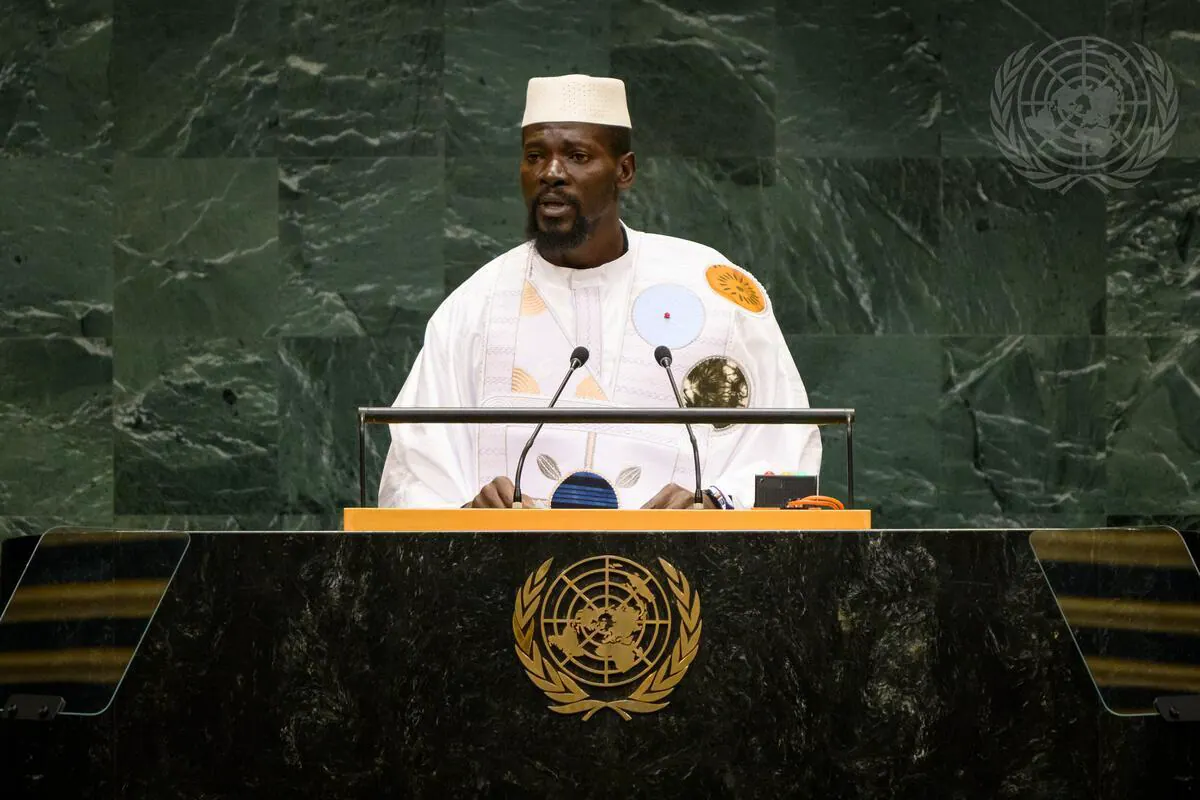
On September 23, Guinean President Mamadi Doumbouya addressed the 81st session of the United Nations General Assembly, providing an update on his country's progress in the areas of politics and economy. He emphasized the need for a refounded international partnership based on mutual respect and adaptation to local realities. This address marks a significant shift from his previous speech three years ago, which was critical of imported political models.
President Doumbouya highlighted Guinea's autonomous electoral process, which was conducted independently with financial and organizational independence. He noted that the country had successfully organized its presidential, legislative, and communal elections, financing them entirely through the Guinean Treasury. The elections were reportedly conducted without significant incidents, demonstrating that a country can organize credible, peaceful, and transparent elections using its own resources.
The Guinean President also focused on the country's socio-economic achievements over the past three years, including the construction of over 1,000 km of paved roads, as well as improvements in school and healthcare infrastructure. He emphasized the importance of locally adding value to the country's natural resources, rather than simply exporting raw materials. To achieve this goal, he cited the construction of three alumina refineries and the largest gold refinery on the continent.
President Doumbouya highlighted the Simandou 2040 program as a key strategy for driving Guinea's structural transformation. He described the program as a lever for accelerating development in areas such as infrastructure, agriculture, energy, education, and healthcare. The program is also expected to prioritize the needs of Guinea's youth, who are considered the country's greatest wealth.
The Guinean President drew inspiration from the development trajectories of Asia and the Middle East, reaffirming his conviction that Africa's sustainable development depends on its ability to take ownership of its own governance levers. He argued that when governance models are adapted to a nation's historical, social, and cultural realities, development accelerates.
President Doumbouya emphasized that Guinea's approach does not represent a rejection of the international community or cooperation, but rather an invitation to build equal and respectful partnerships. He expressed Guinea's commitment to international law and the principles of the UN Charter, and expressed hope that his country's recent progress would inspire collective reflection on the diversity of development paths in Africa.
The President concluded his address by reiterating Guinea's commitment to forging partnerships based on co-construction and mutual respect, rather than pre-established schemes. He expressed his hope that Guinea's experience would serve as an example for other nations and contribute to a more nuanced understanding of development pathways in Africa.
Key points
- Guinea has made significant progress in its electoral process, conducting autonomous and incident-free elections.
- The country's Simandou 2040 program aims to drive structural transformation and accelerate development in key sectors.
- President Doumbouya is advocating for a new approach to international partnerships, based on mutual respect and adaptation to local realities.