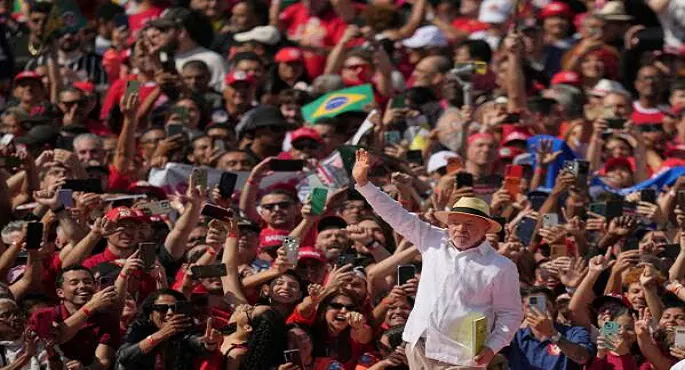
Brazilians began casting their votes on Sunday, October 4, 2026, in the highly anticipated presidential election. The competition is fierce, with 11 candidates vying for the top spot. Incumbent President Luiz Inácio Lula da Silva, a leftist, is facing off against Flávio Bolsonaro, a right-wing candidate and a prominent figure in Brazilian politics. Recent polls suggest a tight race between the two, with Lula da Silva holding a slight lead.
The election takes place against the backdrop of a tumultuous political landscape. The previous presidential election, held four years ago, saw Lula da Silva win by a narrow margin against Jair Bolsonaro, Flávio's father. The aftermath was marked by intense protests and violence, culminating in the storming of the Brazilian Congress by Bolsonaro supporters. Lula da Silva's victory was later confirmed, but not before his predecessor, Bolsonaro, was accused of planning a military coup.
According to recent polls conducted by BBC Brazil, Lula da Silva and Flávio Bolsonaro are neck and neck, with both candidates polling around 40%. The remaining 11 candidates trail far behind, with none exceeding 4% support. If no candidate secures 50% of the valid votes in the first round, the top two contenders will face off in a runoff election scheduled for October 25, 2026.
Approximately 160 million eligible Brazilian voters are set to cast their ballots, with voting mandatory for citizens between 18 and 70 years old who are literate. Failure to vote may result in financial penalties. The large number of eligible voters and the inherent uncertainty of polls, which typically sample only a few thousand individuals, mean that the final results may diverge significantly from current polling trends.
Lula da Silva's campaign has focused on building on his previous successes, including economic growth and social welfare programs. Flávio Bolsonaro, on the other hand, has campaigned on a platform of conservative values and law and order. The election's outcome will likely have significant implications for Brazil's economic and social policies, as well as its relationships with other countries.
International observers are closely watching the election, given Brazil's significant role in regional and global affairs. The country's economy is the largest in Latin America, and its environmental policies have a substantial impact on the Amazon rainforest. A peaceful transfer of power is expected, but any disputes or irregularities could lead to controversy and diplomatic attention.
The Brazilian electoral commission has implemented measures to ensure the integrity and transparency of the voting process. Electronic voting machines will be used, and observers from various organizations will monitor the polls. The commission has also established a system for reporting and addressing any irregularities or complaints.
Key points
- Lula da Silva and Flávio Bolsonaro are in a tight race, with recent polls suggesting a slight lead for the incumbent president.
- The election's outcome will have significant implications for Brazil's economic and social policies.
- Approximately 160 million eligible voters are set to cast their ballots in the election.