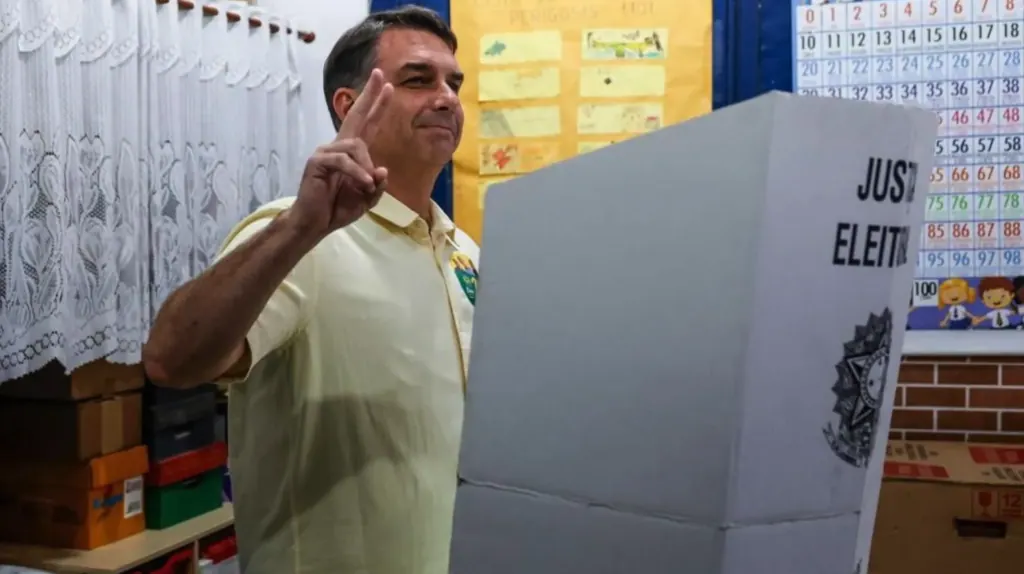
The first round of Brazil's presidential election has concluded with right-wing candidate Flávio Bolsonaro securing 47.03% of the vote, narrowly edging out incumbent left-wing President Lula da Silva, who garnered 45.16%. With 99% of the votes counted, Bolsonaro's result has exceeded expectations, positioning him favorably for the upcoming run-off vote scheduled for 25 October. This development sets the stage for a highly anticipated contest between the two major candidates.
Flávio Bolsonaro, son of former right-wing President Jair Bolsonaro, is currently serving a 27-year prison sentence for masterminding a failed coup attempt. Jair Bolsonaro had been banned from running for re-election and endorsed his eldest son, Flávio, to run in his place. Flávio's campaign has polarized Brazil, with key issues including sovereignty, crime, the economy, and corruption. His Liberal Party (PL) also made significant gains in the concurrent congressional elections.
The election campaign highlighted the stark contrasts between the two leading candidates. Lula da Silva, 80, emphasized the importance of democracy, warning that the choice was between democracy and "barbarism". In contrast, Flávio Bolsonaro, 45, positioned himself as a champion of freedom, stating his desire to "free the Brazilian people". The candidates have distinct voter bases, with Lula being more popular in Brazil's poorer northeast.
Lula da Silva is seeking a fourth term in office, having previously been elected in 2002, 2006, and 2022. His 2022 victory over Jair Bolsonaro was by a margin of less than 2%, marking the closest presidential election result in Brazil's history. The election outcome has significant implications for Latin America, as the region has recently seen a trend towards right-wing presidents aligned with the Trump administration.
Flávio Bolsonaro's support base appears to be concentrated in the south and among wealthier voters and evangelical Christians. He has pledged to grant amnesty to his father and supporters responsible for the January 8th riots if elected. His campaign has resonated with voters concerned about crime and the economy.
The run-off election will determine whether Brazil, Latin America's largest country and economy, will align with the recent trend of electing right-wing presidents in the region. Lula da Silva has expressed confidence that he can still win the run-off, stating that the race is far from over. Flávio Bolsonaro, on the other hand, has expressed optimism about his chances.
The outcome of the election has significant implications for Brazil and the wider region. Jair Bolsonaro's wife, Michelle, was elected to the Senate, further solidifying the family's influence in Brazilian politics. As the country prepares for the run-off, both candidates are expected to intensify their campaigns, appealing to undecided voters and solidifying their support bases.
Key points
- Flávio Bolsonaro leads the first round with 47.03% of the vote.
- A run-off election is scheduled for 25 October.
- The election outcome has significant implications for Latin America's political landscape.