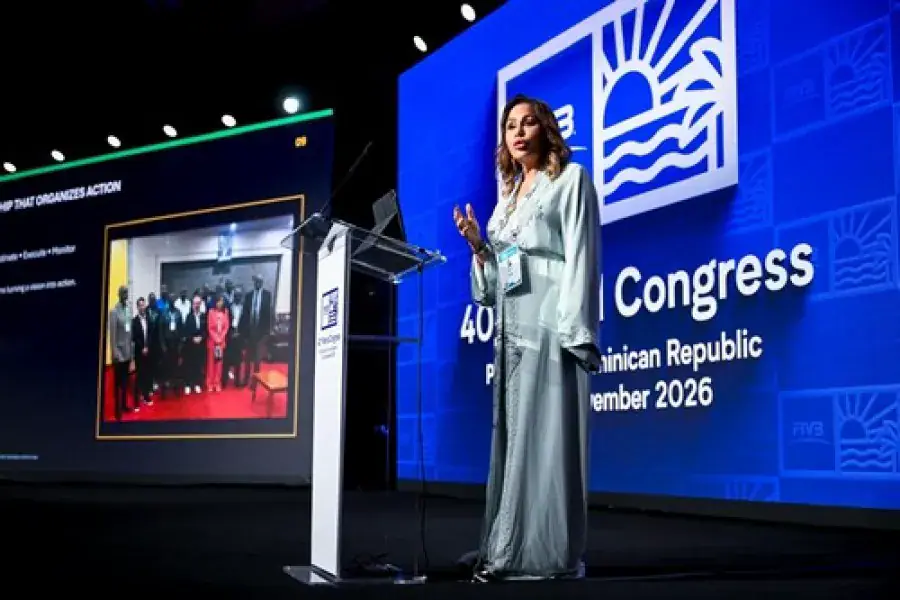
Bouchra Hajij, president of the Confédération africaine de volleyball (CAVB) and vice-president of the Fédération internationale de volleyball (FIVB), recently attended the 40th FIVB Congress in Punta Cana, Dominican Republic. During the event, Hajij presented a detailed report on CAVB's activities, highlighting progress made in African volleyball administratively, organizationally, technically, and in development. Her intervention emphasized the continent's growing ambitions, particularly in strengthening national federations, improving competition levels, training technical and administrative staff, and consolidating Africa's presence on the international volleyball scene.
The CAVB comprises 54 national federations divided into seven zones. Over the past period, 36 competitions were organized in 11 African countries, demonstrating an expansion of the host country map beyond traditional volleyball centers. Countries like Kenya and Rwanda have contributed to this geographical expansion, providing more federations with the opportunity to gain organizational experience, improve infrastructure, and promote volleyball to new audiences. This development reflects the growing diversity and reach of volleyball across the continent.
One of the key achievements highlighted by Hajij was the development of African refereeing, with 61 new international referees qualifying through CAVB training programs. This includes 30 indoor volleyball referees and 31 beach volleyball referees, strengthening Africa's representation in international refereeing and contributing to improved competition management on the continent. The cooperation with FIVB, particularly through the "Volleyball Empowerment" program, has been instrumental in supporting national federations and enhancing their technical and organizational capacities.
The investments in African volleyball development have exceeded $9 million through 461 projects, according to FIVB figures announced in September 2026. These initiatives include support for coaches, transfer of technical expertise, and provision of sports equipment, aimed at helping national federations improve their programs and prepare their teams. The focus on development and capacity building underscores the commitment to elevating the standard of volleyball in Africa.
Beyond sports development, Hajij's report addressed progress in CAVB's administrative and financial management. She emphasized that good governance and transparency are essential foundations for building a solid sports institution. The successful completion of two external financial audits without reservations testifies to CAVB's commitment to financial responsibility and rigorous management. Modernization efforts, including multi-year planning for competitions and the use of technology such as Video Challenge and electronic match sheets, were also highlighted.
The CAVB is prioritizing communication and marketing to enhance the visibility of African volleyball through digital platforms, improve media coverage of competitions, and offer African athletes greater visibility while attracting new audiences, sponsors, and partners. For 2027-2028, Hajij outlined six strategic commitments focusing on strengthening national federations, improving competition levels, intensifying training programs, supporting infrastructure, increasing media visibility, and pursuing governance and transparency efforts.
In conclusion, Hajij's participation in the 40th FIVB Congress underscores the growing role of African leadership in shaping the future of international volleyball. Her presentation reflected Africa's ambitions, emphasizing the need to transform potential into strength. With her leadership roles in CAVB, FIVB, and the Association of African Olympic Sports Confederations, Hajij is contributing to a stronger presence for Africa in international sports governance and decision-making.
Key points
- Over $9 million invested in African volleyball development through 461 projects.
- 61 new international referees qualified through CAVB training programs.
- 36 competitions organized in 11 African countries, expanding volleyball's reach.
Reporting sources
- Bouchra Hajij met en lumière les réalisations... · Maliweb.net