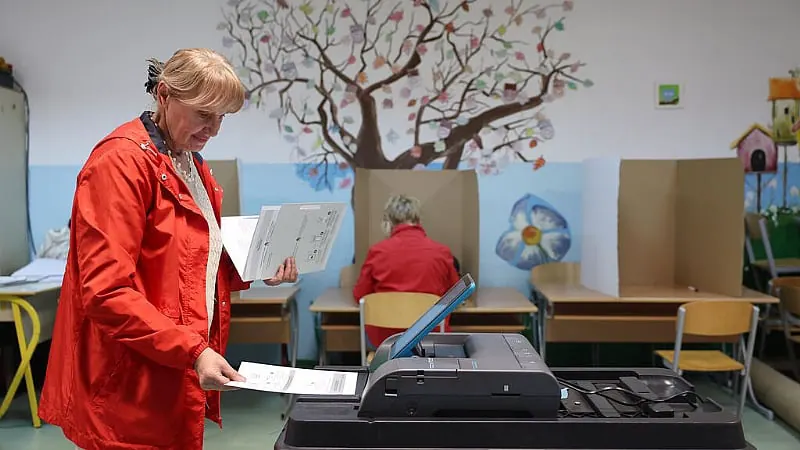
Bosnia and Herzegovina is holding a general election on Sunday, with around 3.4 million voters choosing the country's multi-ethnic presidency, lawmakers, and heads of institutions for its two entities. The election comes amid ethnic tensions and the influence of pro-Russian politician Milorad Dodik, who has been banned from holding public office but is still dominating the campaign. Dodik's party, the Alliance of Independent Social Democrats, is likely to win the election in the Serb-majority Republika Srpska.
Dodik, a staunchly pro-Russian politician, has been convicted of defying decisions by the international envoy overseeing the 1995 peace agreement and has been banned from holding public office. Despite this, he has been using his influence to inflame divisions and spark fears of renewed instability. At his party's final election rally on Friday night, Dodik told supporters that Bosnia "is dead" and that it is "an impossible country."
The election is taking place in a country that is still struggling to recover from the devastating war of 1992-95, which killed more than 100,000 people and displaced millions. Bosnia has a complex web of governing institutions created by a US-brokered peace agreement in 1995 to manage ethnic divisions between Muslim Bosniaks, Orthodox Serbs, and Catholic Croats. The country's politicians have kept alive the divisions between the country's Bosniaks, Serbs, and Croats, with Bosnian Serb leaders like Dodik pushing for the separation of their entity from the rest of Bosnia.
Despite the challenges, there are hopes that the election will bring about change. Many disillusioned citizens say politicians are using nationalism to avoid solving important problems such as poor living standards and an exodus of youth from the country. Ivan Silic, a resident of the southern town of Mostar, said he doesn't see anything getting better and that politicians are only looking out for themselves.
The country's wartime wounds were recently revived by a public homage in Serbia and among Bosnian Serbs to the wartime army commander Ratko Mladic, who died in late August while serving a life sentence for genocide and other war crimes. Bosnian Serbs view Mladic as a hero despite his conviction by a UN court over the massacre of more than 8,000 Muslim men and boys in Srebrenica in 1995.
Authorities are taking steps to ensure the fairness of the election, including the use of electronic identification of voters and scanning of ballots to prevent irregularities or organized voter manipulation. Salko Bijavica, from the southern town of Mostar, said he is glad that "every vote will be counted" and that the change will give "hope to people that elections will be fair".
The election outcome is uncertain, but one thing is clear: the country's future is at a crossroads. Bosnia is formally seeking to join the European Union, but progress toward membership has been stalled despite EU efforts to encourage Bosnia's divided leaders to work together for reform. The country's residents are hoping for change, with Durak Miler, a resident of the Bosnian capital of Sarajevo, saying that governing politicians "just poison people when they talk" and that "we should change the old faces".
Key points
- Milorad Dodik's influence on the election despite being banned from public office.
- The country's ongoing ethnic tensions and their impact on the election.
- The challenges facing Bosnia as it seeks to join the European Union.