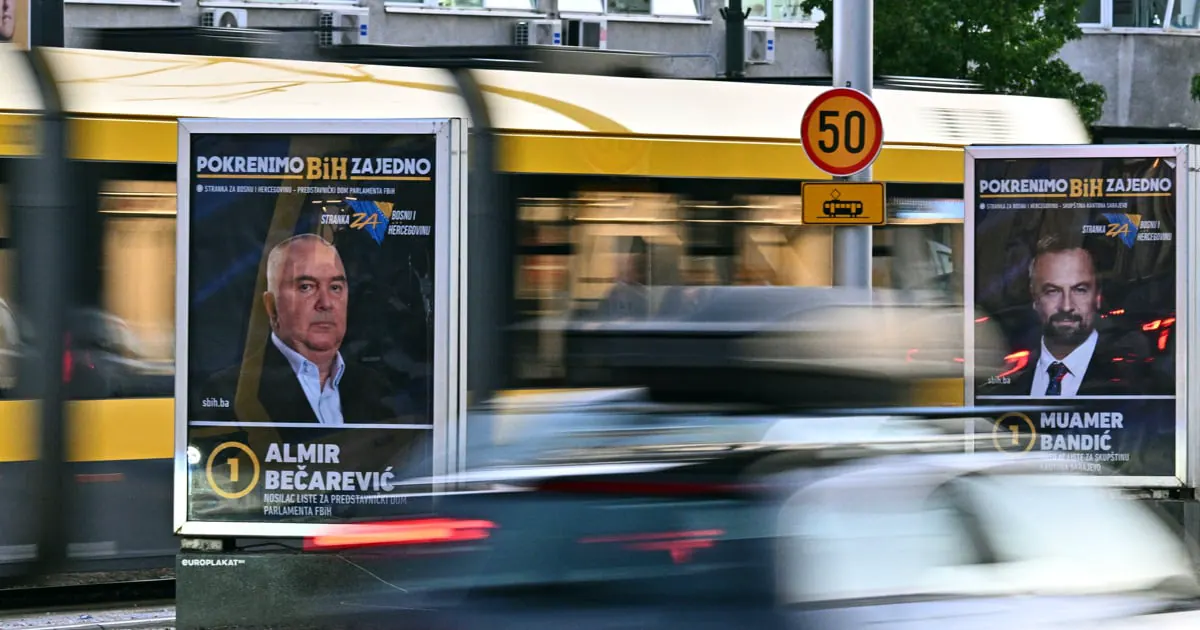
Bosnia and Herzegovina is heading to the polls after a general election campaign dominated by parties closely tied to the ethnic divisions of its 1990s war. The complex system, established by the 1995 peace deal, has maintained the partitioned country. Voters will elect numerous officials across multiple tiers of government. The key race is for the tripartite presidency, split among Bosnian Muslims or Bosniaks, and the Serb and Croat ethnic groups.
The major parties' focus on war-era rhetoric and division has frustrated some voters. Activist Adi Selman of the Karton Revolucija protest group expressed concerns that the new elections may not bring change. He stated that the choice is limited to political parties that have been around for 30 years, relying on war, tensions, divisions, and the past to secure votes. Many young Bosnians are leaving the country due to the political deadlock.
The US-brokered Dayton agreement ended the 1992-1995 conflict but entrenched divisions that often paralyze decision-making. Bosnia is divided into two semi-autonomous entities - the Serb-run Republika Srpska (RS) and a Muslim-Croat federation - linked by a weak central government. The Serb entity's former president, Milorad Dodik, remains a central figure despite being convicted and banned from the presidency for six years.
Dodik's regular separatist threats have led to repeated clashes with central authorities, stymying hopes of political cooperation. Despite his two decades of dominance in RS, researcher Adnan Cerimagic believes it's not impossible for opposition candidate Branko Blanusa to beat Dodik-backed Savo Minic in the RS presidency race. The outcome is uncertain, and Dodik's grip on power may be tested.
In the Muslim-Croat federation, Bosniak parties are pushing for a stronger central state, with incumbent Bosniak presidency member Denis Becirovic pledging a renewed path to the European Union and NATO. However, little progress has been made on this front in years. Croat nationalist parties demand electoral reform, seeking a greater say in choosing the Croat member of the presidency.
The start of voting was delayed in dozens of polling stations due to technical issues, as Bosnia rolled out biometric identification and scanning technology for the first time. Polls closed at 7:00 pm, and first results are expected late Sunday. The situation has never been worse, according to 29-year-old environmental activist Sara Tusevljak, as many young Bosnians leave the country due to the political deadlock.
The elections have significant implications for Bosnia's future, with the country's progress toward the European Union and NATO hanging in the balance. The outcome will determine the trajectory of the country's development and its relations with neighboring countries. The international community is closely watching the elections, hoping for a peaceful and democratic transfer of power.
Key points
- The complex system established by the 1995 peace deal maintains the partitioned country.
- The major parties' focus on war-era rhetoric and division has frustrated some voters.
- The outcome of the elections will determine Bosnia's future progress toward the European Union and NATO.