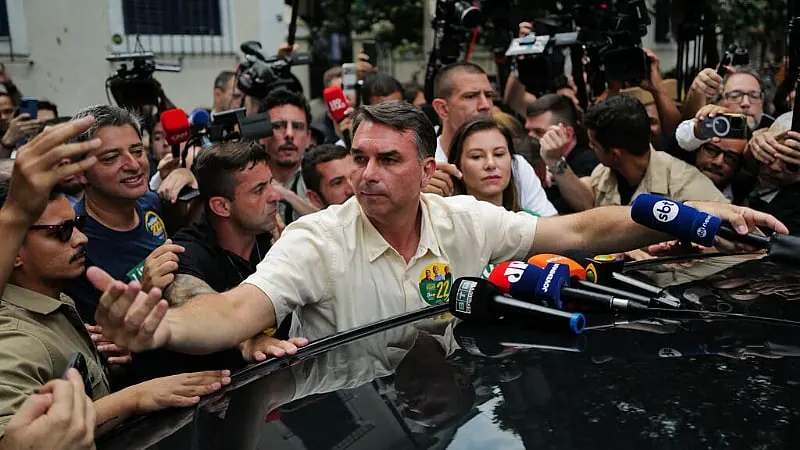
The Bolsonaro family has claimed victory in every race they contested in Brazil's recent polls. Flavio Bolsonaro, the eldest son of former far-right president Jair Bolsonaro, secured 47 percent of votes, surpassing President Luiz Inacio Lula da Silva's 45 percent in a first-round vote. The pair will now clash again in an October 25 runoff. Flavio Bolsonaro was chosen by his father to continue the family's political project after Jair Bolsonaro was convicted of coup-plotting and barred from running for office until 2030.
Flavio Bolsonaro, a 45-year-old senator, is well-positioned to potentially become president. His rise to prominence was facilitated by his selection by his father to lead the family's political endeavors. Jair Bolsonaro's conviction and subsequent ban from running for office until 2030 paved the way for Flavio to take the reins. The Bolsonaro family's Liberal Party has emerged as a dominant force in Brazilian politics, securing 19 of 54 Senate seats up for grabs, although it fell short of an outright majority.
Other members of the Bolsonaro family also performed well in the polls. Jair Bolsonaro's wife, Michelle Bolsonaro, secured more votes than any other candidate in her bid to become a senator in the capital Brasilia's Federal District. Commentators believe that Michelle Bolsonaro may be eyeing a presidential bid of her own in 2030. Her success, combined with that of other family members, has solidified the Bolsonaro family's position as a major force in Brazilian politics.
The Bolsonaro family's success was not limited to Flavio and Michelle. Carlos Bolsonaro, the second son, was the second most voted senatorial candidate in the southern Santa Catarina state. Eduardo Bolsonaro, the third son, gave up his seat as a lawmaker when he moved to the United States last year. The youngest Bolsonaro brother, Jair Renan, 28, was elected a federal deputy in the same state. Additionally, Jair Bolsonaro's brother, Renato Bolsonaro, 62, was also elected a federal deputy in Sao Paulo.
The Bolsonaro family's electoral success has significant implications for Brazilian politics. If Flavio Bolsonaro becomes president, he will be able to count on two senators and two federal lawmakers in the family as he attempts to fulfill a campaign promise to secure amnesty for his jailed father. Such a move would require a vote by both houses of Congress. The Liberal Party will also be the largest in the Chamber of Deputies, giving them considerable influence over the legislative agenda.
The outcome of the election has also dealt a blow to President Lula's policy ambitions. Even if Lula is re-elected, he will have a tough time trying to push policies through chambers dominated by conservative lawmakers. The Bolsonaro family's success has ensured that the Liberal Party will play a major role in shaping Brazil's legislative agenda, potentially limiting Lula's ability to implement his policies.
The Bolsonaro family's rise to prominence has raised questions about the future of Brazilian politics. With Flavio Bolsonaro potentially becoming president and other family members holding key positions, the Bolsonaro family's influence is likely to be felt for years to come. As Brazil prepares for the runoff election, the country is bracing for a prolonged period of conservative leadership.
Key points
- Flavio Bolsonaro secured 47 percent of votes, surpassing President Luiz Inacio Lula da Silva's 45 percent in a first-round vote.
- The Bolsonaro family's Liberal Party secured 19 of 54 Senate seats up for grabs, becoming the largest force in the Senate.
- Michelle Bolsonaro may be eyeing a presidential bid of her own in 2030.