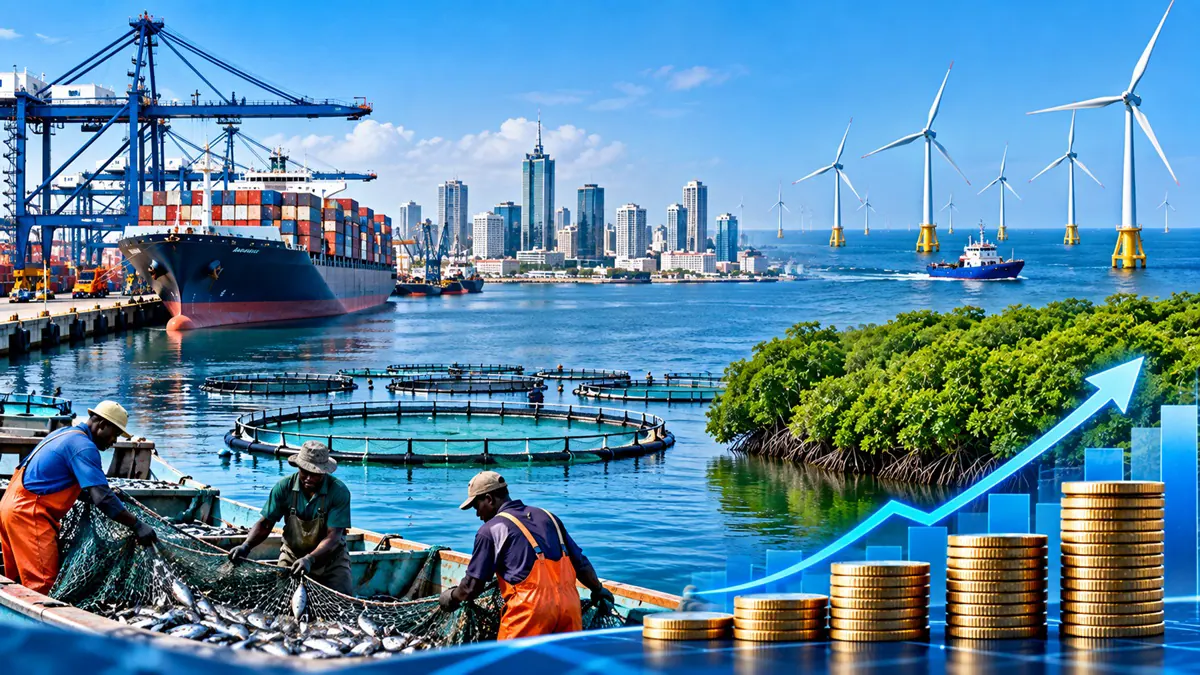
Nigeria's budget deficits remain exceptionally high, partly driven by heavy debt servicing obligations. The country's blue economy is facing a severe capital shortfall, requiring about $10 billion in investment over the next ten years to fully unlock its potential. The current federal budgetary allocation of ₦10.5 billion remains grossly inadequate to drive meaningful impact. This lack of investment has left the sector's opportunities underutilised for many years.
The blue economy offers various prospects, including shipping, fisheries and aquaculture, marine tourism, coastal infrastructure, renewable energy, and ocean research. Nigeria's annual fish imports stand at $1.2 billion, addressing a domestic supply shortfall of about 2.2 million metric tonnes. This import dependence further drains the country's foreign exchange earnings and undermines stability. With its strategic location along the Atlantic Ocean, Nigeria can become a dominant coastal transportation and maritime logistics hub in Africa.
A comprehensive policy framework was approved by the Federal Government in May 2025, providing a roadmap for harnessing Nigeria's vast coastal and inland water resources. However, mobilising capital for implementation remains a challenge. Innovative financing is essential to diversify the economy without worsening public debt. Alternative financing mechanisms, including blue bonds, blended finance, and thematic instruments, can mobilise billions in new capital for infrastructure development in Nigeria.
Blue finance is a rapidly growing area of climate finance that directs investments toward projects and infrastructure that support a sustainable blue economy. It involves specialised financial instruments such as blue bonds, blue loans, and debt-for-nature swaps. Seychelles issued the world's first sovereign blue bonds in 2018, raising $15 million for marine conservation and fisheries governance. In 2023, Gabon issued a $500 million sovereign blue bond as a debt-for-nature swap to refinance national debt and fund marine conservation.
Experts suggest that governments should embed blue finance in national development plans, provide capacity-building for relevant stakeholders, and strengthen performance metrics and transparency standards. Development banks and multilateral institutions should consider providing tailored technical assistance and concessional capital to de-risk such capital investments. Co-created investment platforms and blended finance mechanisms should be encouraged to provide incentives and share risks.
Professionals are actively advocating for the deployment of sovereign and corporate blue bonds in Nigeria. However, a structured, functional domestic blue bond market does not yet exist. After the issuance of green bonds in 2025, the regulatory environment seems to have slipped into official inertia. Nevertheless, a few commercial banks continue to pay some attention to projects that mainstream sustainability, yet many of them lack specialised marine lending frameworks.
Blue finance must become the preferred option for capital mobilisation as Nigeria seeks to diversify away from oil dependence. The extensive mangroves and coastal ecosystems in the Niger Delta offer entry points into the blue carbon market. These sustainable nature-based solutions provide revenue streams that tie direct capital flows to environmental preservation. Scaling up such initiatives can give coastal communities a ladder into the carbon marketplace.
Key points
- Nigeria's blue economy requires $10 billion in investment over the next ten years to fully unlock its potential.
- A comprehensive policy framework for harnessing Nigeria's coastal and inland water resources was approved in May 2025.
- Blue finance involves specialised financial instruments such as blue bonds, blue loans, and debt-for-nature swaps.