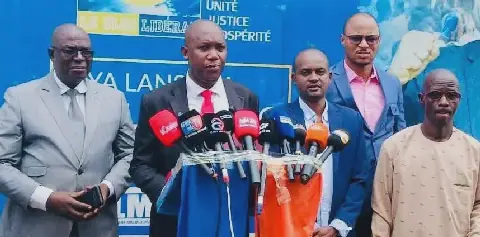
Rev. John Ntim Fordjour, the Ranking Member on Parliament's Defence and Interior Committee, has expressed concerns that the Speaker's decision to reject the Minority's motion for an inquiry into recent cocaine seizures lends weight to claims of political protection for drug traffickers in Ghana. The motion sought to investigate how major consignments of cocaine were processed, inspected, cleared, and exported from Ghana. Rev. Ntim Fordjour made these comments on Joy News, following an emergency sitting of Parliament.
The Speaker, Alban Bagbin, ruled the Minority's motion seeking the establishment of an ad hoc committee to investigate recent narcotics seizures inadmissible. This decision has sparked controversy, with Rev. Ntim Fordjour arguing that it corroborates concerns raised in the 2025 Global Organised Crime Index. The report suggests that political protection may help explain a decline in visible cocaine trafficking in Ghana, citing concerns from law enforcement officials and civil society stakeholders.
According to Rev. Ntim Fordjour, if the concerns about political protection were unfounded, there would have been no reason to prevent a bipartisan parliamentary investigation. He stated that the decision to block the inquiry suggests there may be information the government and the Majority do not want exposed. The Assin South MP argued that the proposed investigation was not merely a partisan political exercise, as it had received support from various organisations.
The Minority's push for an inquiry had received support from organisations including the Catholic Bishops' Conference, the Christian Council of Ghana, and other civil society groups. Rev. Ntim Fordjour noted that this support demonstrated the importance of the proposed investigation. He also stated that the decision to block the inquiry tells us that there is something the government and the Majority are hiding.
Rev. Ntim Fordjour further stated that the Speaker's decision, along with the Majority's support, goes to corroborate the points raised in the Global Organised Crime Index. The report alleges that persons and groups peddling drugs and trafficking cocaine in Ghana receive political protection. The Assin South MP expressed concerns that the government's actions may be protecting drug cartels.
The 2025 Global Organised Crime Index report raises concerns about the decline in visible cocaine trafficking in Ghana, suggesting that falling seizures and reduced media coverage could conceal continued trafficking activity. Rev. Ntim Fordjour's comments have sparked a renewed debate about the role of politics in Ghana's fight against drug trafficking.
The controversy surrounding the blocked inquiry has sparked reactions from various stakeholders, with some calling for a bipartisan approach to addressing the issue of drug trafficking in Ghana. The Minority Leader and other MPs have expressed concerns about the Speaker's decision, calling for a parliamentary inquiry into the matter.
Key points
- The Speaker of Parliament's decision to block the Minority's motion for an inquiry into recent cocaine seizures has fueled concerns about political protection for drug traffickers in Ghana.
- The 2025 Global Organised Crime Index report suggests that political protection may help explain a decline in visible cocaine trafficking in Ghana.
- The Assin South MP, Rev. John Ntim Fordjour, argues that the decision to block the inquiry suggests there may be information the government and the Majority do not want exposed.