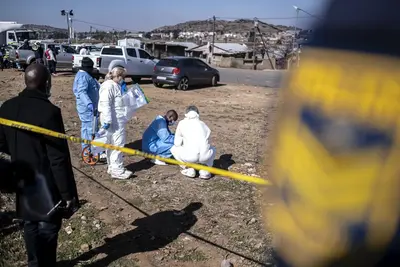
The death of 38-year-old Elizabeth “Tsontso” Moselakgamo, who was found after going missing while jogging in Kempton Park, has added to a series of disturbing cases under investigation in Ekurhuleni. Nine women’s bodies have been discovered across the region over approximately two months. Police have not confirmed that the deaths are the work of a serial killer, but a multidisciplinary task team is investigating whether the cases are connected.
According to official national crime statistics, 569 women were murdered in South Africa between April and June 2026. This past week alone, another body was found in Soweto, bringing the total number of families grieving to ten. Communities are frightened, and women are once again being warned to restrict their movements to protect themselves. The question remains why women are still being asked to disappear.
The burden of violence is often placed on the person who suffered it, with questions focusing on their behavior. Why was she alone? Why did she go there? Why was she outside at that time? These questions place the blame on the victim instead of the perpetrator. South Africa cannot continue responding to violence against women by shrinking women’s lives and limiting their freedom.
The country’s first national gender-based violence study found that 35.5% of women aged 18 and older had experienced physical or sexual violence in their lifetime, representing an estimated 7.8 million women. Children are also affected, with Statistics South Africa reporting that rape accounted for 38.3% of recorded crimes against children in 2022/23.
Government and law-enforcement agencies must respond decisively to the crisis. Investigations must be properly resourced, public spaces assessed for safety, and perpetrators found, prosecuted, and convicted. Technology can help create a critical window for emergency responses but cannot replace effective policing, functioning courts, and community vigilance.
The Khoi Afriwatch S, a wearable device, was developed to provide an additional layer of support. It includes a dedicated SOS button, location-tracking capability, and a direct line of communication from the wrist. For a child travelling between school and home, an elderly family member living independently, or a woman exercising outdoors, the device may provide a vital connection.
Safety must enable freedom, not restrict it. The national conversation must shift from “Stop living because the world is dangerous” to “How can we protect you while you continue living?” This means equipping women and children with practical tools, building community response networks, improving public infrastructure, and strengthening policing.
Key points
- South Africa reported 569 women murdered between April and June 2026.
- 35.5% of women aged 18 and older have experienced physical or sexual violence in their lifetime.
- Technology can create a critical window for emergency responses but cannot replace effective policing and community vigilance.