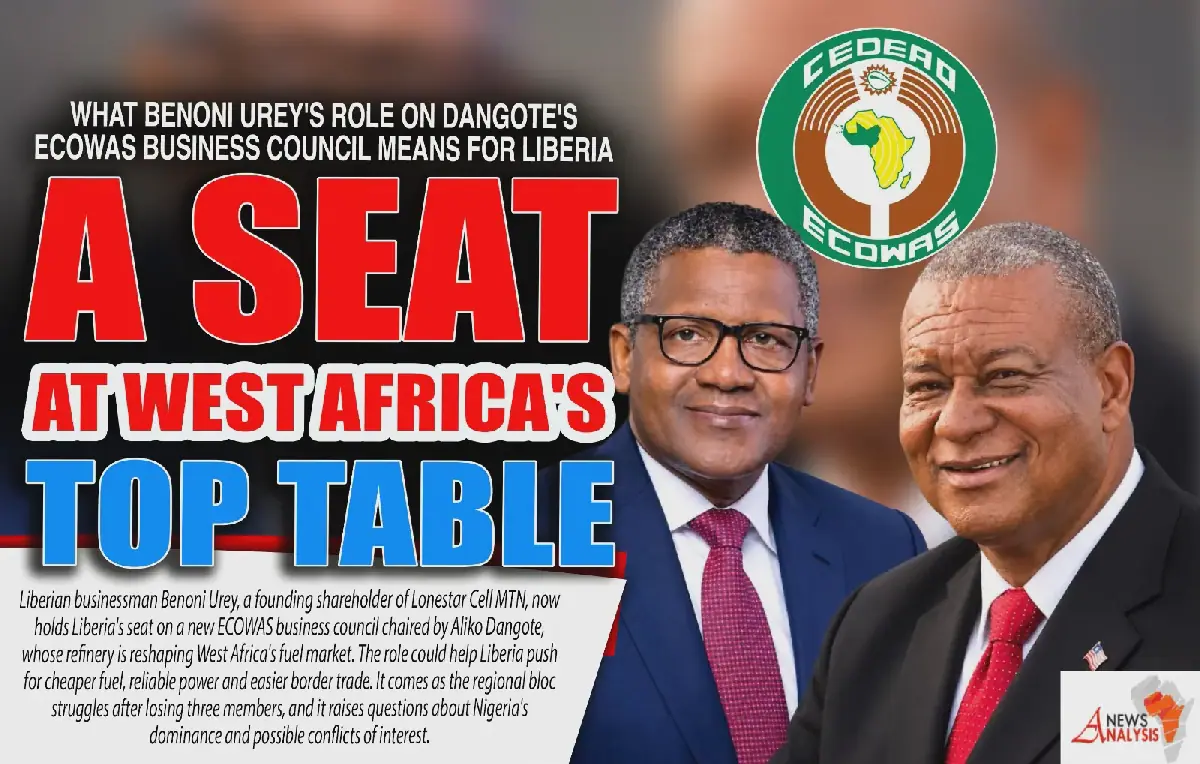
Liberian businessman Benoni W. Urey, a founding shareholder of the mobile network Lonestar Cell MTN, has been named Liberia's representative on the ECOWAS Business Council. The council is a new advisory body chaired by Nigerian industrialist Aliko Dangote, Africa's richest man. Its purpose is to give the private sector a direct line to the presidents of West Africa. This appointment comes at a delicate moment for the regional bloc, which has lost three members and seen its trade ambitions stalled.
The Economic Community of West African States, or ECOWAS, was founded in Lagos, Nigeria, in 1975, with Liberia as one of its founding members. For many Liberians, ECOWAS is associated with peacekeeping rather than trade, thanks to its military force, ECOMOG, which entered Liberia's civil war in 1990. ECOWAS mediators also helped broker the 2003 peace agreement in Accra, Ghana, that ended 14 years of conflict. Despite its economic promise, the bloc has shrunk, with the military-led governments of Mali, Burkina Faso, and Niger formally walking out in January 2025.
The ECOWAS Business Council was created on paper in 2021, but its launch was delayed until September 2025. Dangote was named its first chairman by the bloc's foreign ministers in Abuja in December 2025. The council's job is to advise ECOWAS leaders on trade, investment, and industrial policy, and to help clear barriers to the free movement of people, goods, services, and money across the region's borders. Each member state has one representative, with Nigeria, the region's largest economy, having two additional seats.
For Liberia, a country of about five million people, the stakes are practical. It trades heavily with neighboring Sierra Leone, Guinea, and Côte d'Ivoire, imports almost all of its fuel, and depends on regional power lines and road links that ECOWAS helps plan and fund. The council's focus on energy corridors, ports, and logistics could bring benefits to Liberia, including shorter supply chains, more reliable deliveries in a crisis, and cleaner fuel.
However, concerns have been raised about the concentration of influence in the hands of Dangote, whose refinery outside Lagos has cut West Africa's imports of refined fuel from outside the region by close to a quarter. There are also concerns about conflict of interest, given Dangote's empire spans cement, sugar, fertilizer, and petroleum – all sectors shaped by tariffs, import rules, and industrial policy. Nigerian business interests may carry outsized influence in the council's decisions, given the country's three seats and the chairmanship.
The council's success will depend on its ability to produce rules that open up the region to trade and investment, and whether its members speak for market traders and young companies, not just the region's biggest conglomerates. Business councils across Africa have often become talking shops, but this one will be judged on results, including fewer roadblocks, faster customs clearance, and power projects that actually get built.
The appointment of Benoni Urey as Liberia's representative on the ECOWAS Business Council offers an opportunity for Liberia to shape the region's economic future. The council's work will be closely watched, particularly in Liberia, where pump prices have often run higher than in neighboring countries. A major refinery a few days' sail away could mean shorter supply chains and more reliable deliveries in a crisis.
Key points
- The ECOWAS Business Council, chaired by Aliko Dangote, aims to advise ECOWAS leaders on trade, investment, and industrial policy.
- Liberia's representative on the council, Benoni Urey, will play a crucial role in shaping the region's economic future.
- The council's success will depend on its ability to produce tangible results, including increased trade and investment, and improved economic outcomes for member states.