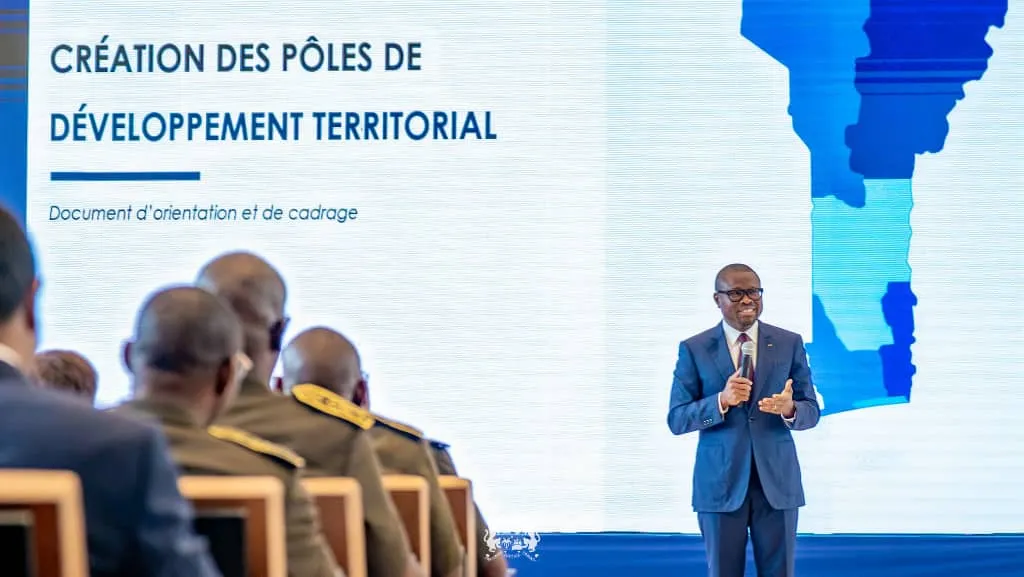
On September 23, Benin's President Romuald Wadagni and Minister for Decentralization and Local Governance presented a territorial reform plan at the Palais de la Marina in Cotonou. The plan aims to make territories a driving force for poverty reduction and wealth creation. The reform seeks to bring public action closer to citizens and better account for the realities of each territory. The presentation was attended by mayors of 77 communes, prefects, members of the Economic and Social Council, and several government officials.
The reform focuses on enabling communes and development areas to better utilize their strengths, whether in agriculture, commerce, tourism, or services. The government's priorities include reducing extreme poverty, promoting human capital, and creating jobs. The plan also emphasizes monitoring results to ensure that public investments have visible effects on the population. According to the government, national development cannot be achieved solely from the center; it must also originate from the territories where people live and opportunities are created.
The territorial reform plan is part of the government's efforts to decentralize power and promote local governance. By bringing together local elected officials, territorial administration, and national institutions, the government aims to create a new dynamic for transforming communes. The ultimate goal is to make each territory a genuine lever for growth and improvement in citizens' living conditions. The reform is expected to have a positive impact on the lives of Benin's population, particularly in rural areas.
The presentation of the reform plan was attended by high-ranking officials, including the President of the National Assembly. The government's commitment to decentralization and local development is seen as a key aspect of its strategy to address poverty and inequality. The plan is expected to be implemented in the coming months, with the government working closely with local authorities and stakeholders.
Benin's decentralization process has been ongoing for several years, with the government seeking to give more autonomy to local authorities. The territorial reform plan is a significant step in this process, as it aims to create a more effective and efficient system of local governance. The plan's success will depend on its implementation and the government's ability to work with local stakeholders.
The government's focus on territorial development is seen as a response to the challenges facing Benin's economy and society. The country has made progress in recent years, but poverty and inequality remain significant challenges. The territorial reform plan is part of a broader strategy to address these challenges and promote sustainable development.
The implementation of the territorial reform plan will be closely monitored by the government and stakeholders. The plan's success will depend on the government's ability to coordinate with local authorities and ensure that the needs of all citizens are taken into account. The reform plan is seen as a key aspect of Benin's development strategy, and its impact will be closely watched in the coming months and years.
Key points
- The reform plan aims to make territories a driving force for poverty reduction and wealth creation in Benin.
- The plan focuses on enabling communes and development areas to better utilize their strengths.
- The government's priorities include reducing extreme poverty, promoting human capital, and creating jobs.