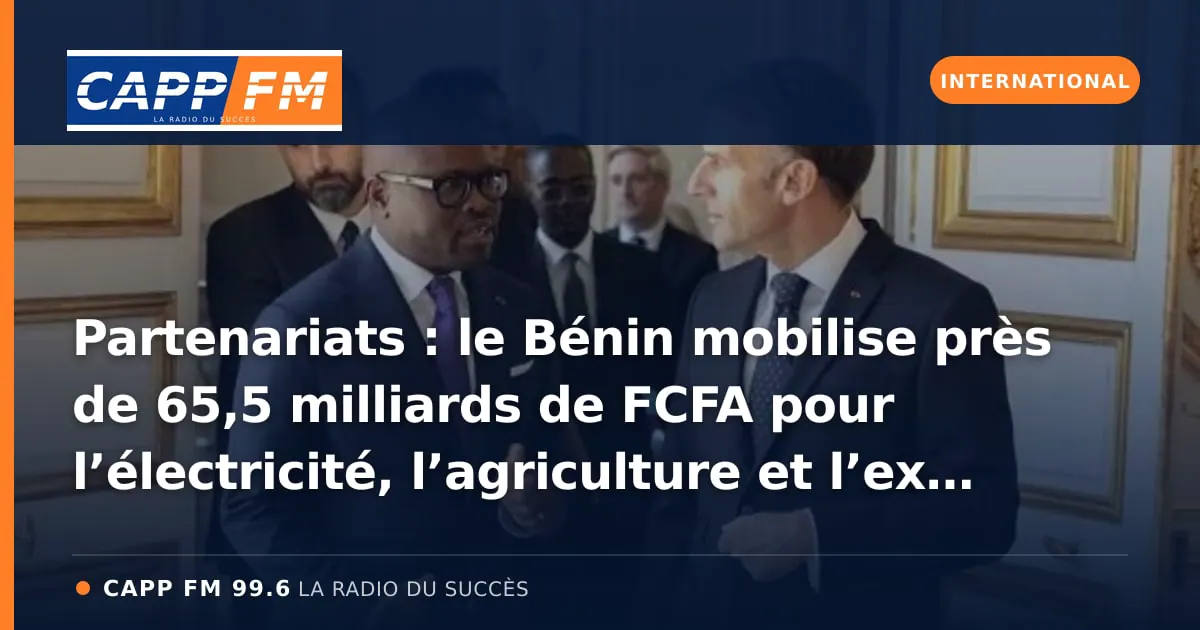
The Republic of Benin has secured approximately 65.5 billion FCFA in partnerships with French institutions to support key development projects. On October 5, 2026, Benin signed two financing conventions with the French Development Agency (AFD) and a mandate letter with Bpifrance. These agreements aim to enhance access to electricity, boost agricultural production, and modernize forensic expertise in the country. The deals were signed in France by Benin's Minister Delegate for External Resource Mobilization and Debt Management.
The two conventions with AFD amount to 61.9 billion FCFA, while the mandate letter with Bpifrance covers 3.54 billion FCFA. These funds will support projects aligned with Benin's development priorities. According to the Beninese government's communiqué, the agreements were signed during a meeting at the Élysée Palace between Minister Romuald Wadagni and French President Emmanuel Macron. The partnerships reflect Benin's efforts to leverage international cooperation for its development agenda.
A significant portion of the funds, 52.1 billion FCFA, will be dedicated to expanding the distribution network of the Société Béninoise d'Électricité et d'Eau (SBEE). This project includes a 32.8 billion FCFA loan from AFD and a 19.3 billion FCFA grant from the European Union. The goal is to improve electricity access across the country, supporting economic growth and poverty reduction.
The agricultural sector will benefit from 9.8 billion FCFA in funding, focusing on pisciculture and local agricultural value chains. This initiative aims to enhance food security and increase farmers' incomes. Additionally, the mandate letter with Bpifrance paves the way for negotiations on financing the Platform for Research, Investigation, and Forensic Analysis (PRIAM). This project involves collaboration with the Bordeaux Laboratory of Forensic Hematology.
The PRIAM project includes the establishment of a national DNA expertise laboratory with a capacity for 30,000 analyses per year. The laboratory aims to achieve international accreditation under the ISO/IEC 17025 standard. The project also encompasses the training of over 500 professionals and the creation of a dedicated university program. These efforts are part of Benin's strategy to enhance its forensic capabilities.
The partnerships signed on October 5, 2026, align with Benin's priority to combat extreme poverty. This priority was reaffirmed on September 23, 2026, during the presentation of the reform of the territorial development poles. The projects funded through these partnerships are expected to contribute significantly to achieving these development goals.
The successful implementation of these projects will depend on effective collaboration between the Beninese government, French institutions, and other stakeholders. The partnerships demonstrate the commitment of both countries to fostering development cooperation. Key outcomes of these projects will include improved electricity access, enhanced agricultural productivity, and advanced forensic expertise.
Key points
- Benin secures 65.5 billion FCFA for development projects.
- Partnerships aim to improve electricity access, boost agriculture, and modernize forensic expertise.
- Projects align with Benin's priority to combat extreme poverty.