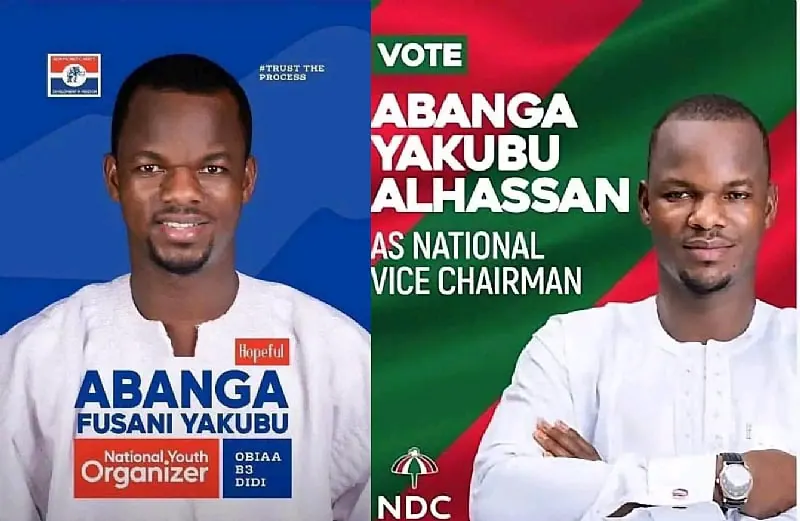
Ghana's politics often seems divided between the NPP and NDC, but the story of twin brothers Fuseini Yakubu Abanga and Alhassan Yakubu Abanga shows that political differences don't have to destroy personal relationships. The brothers have built careers in opposing parties, with Fuseini in the NPP and Alhassan in the NDC. Their situation illustrates that relatives don't have to surrender individual convictions due to family ties.
Fuseini Abanga was the NPP's parliamentary candidate for Aowin in the 2024 general election, while his twin brother Alhassan serves as the NDC's Third National Vice Chairman. During Fuseini's campaign, he acknowledged that his brother campaigned against him. This public display of sibling rivalry highlights the challenges of balancing family loyalty and political allegiance.
Recently, allegations of illegal mining, or galamsey, were raised against Alhassan Abanga. Fuseini, despite being in the rival party, distinguished between his political differences and personal knowledge of his brother. He stated that he had never known his brother to engage in illegal mining and was involved in legitimate mining concessions. This response demonstrated the importance of due process and credible investigation.
Allegations of galamsey are serious, given the environmental and governance challenges they pose. Successive governments have faced pressure to address the issue, particularly regarding politically connected individuals. However, allegations should not be treated as established guilt; investigative institutions must determine the facts. Political affiliation should not provide immunity or substitute for evidence.
The Abanga twins' story highlights the need for democratic maturity in Ghana. The country's politics often prioritizes party loyalty over independent judgment, leading to unnecessary divisions. People are frequently classified by party affiliation rather than as citizens. This culture weakens democratic reasoning and can lead to hostility between citizens with differing views.
The phenomenon of relatives occupying opposing sides of the NPP-NDC divide is not unique to the Abanga twins. The Jinapor brothers, Samuel Abu Jinapor and John Abdulai Jinapor, are another example. Their careers demonstrate that family relationships and political convictions can coexist despite party differences. The Abanga twins make this phenomenon striking due to their identical twin status.
The Abanga twins' story offers a valuable lesson for Ghana: political disagreement and human relationships don't have to be mutually exclusive. Elections should be contests of ideas, records, and policies, not permanent declarations of hostility. Ghana needs more democratic maturity, where politicians can disagree without becoming enemies, and supporters can campaign passionately without insulting one another.
Key points
- The Abanga twins demonstrate that relatives can have differing political convictions without destroying their relationships.
- Ghana's democracy needs to prioritize impartial investigation and due process over party loyalty.
- The country's politics should focus on contests of ideas, records, and policies rather than hostility between citizens.