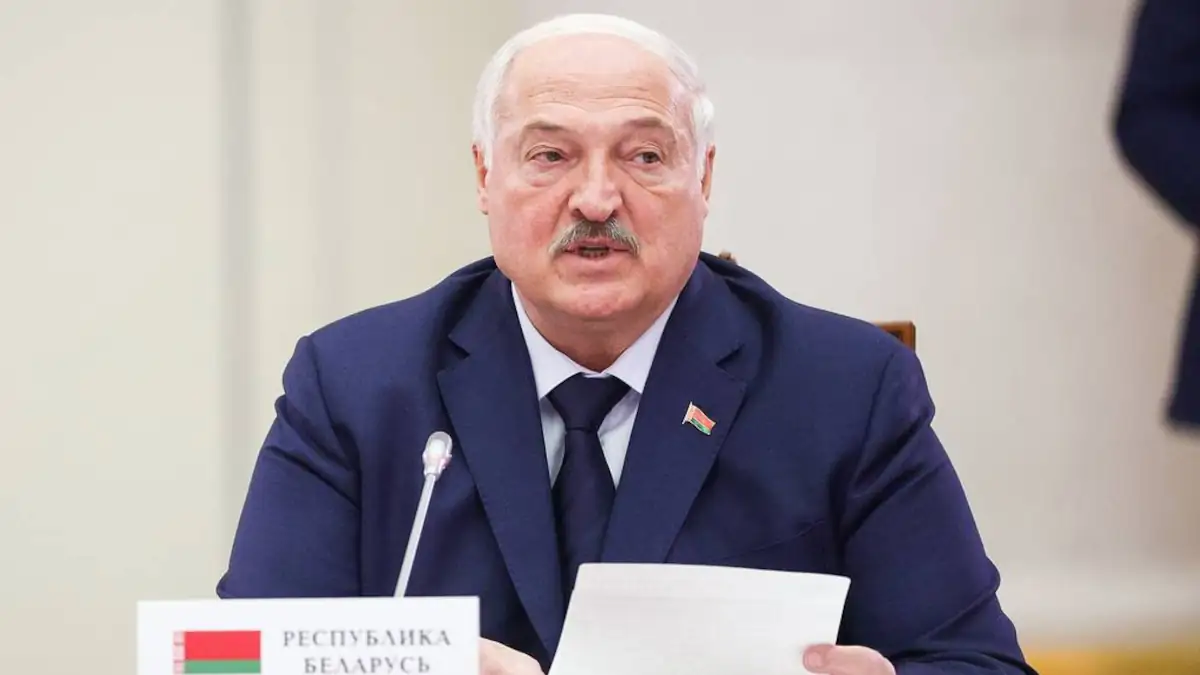
The President of Belarus, Alexander Lukashenko, has made comments on the ongoing conflict between the United States and Iran, suggesting that the war is over Iran's resources. According to a report by Asr-e-Iran, Lukashenko disputed the idea that the conflict is a result of historical clashes between Washington and Tehran. He stated that the reason for the war is not an incident, but rather Iran's wealth. Lukashenko's comments were reported by La Nouvelle Tribune, a Beninese newspaper.
Lukashenko drew parallels between the current conflict and historical events, including World War II. He mentioned that nearly 30 million Belarusians died during the war and questioned whether they should have continued to fight. He emphasized that the current conflict is not about past grievances, but about Iran's resources. The President's comments have sparked interest in Benin and other parts of Africa, where the implications of the conflict are being closely watched.
The history of Iran's oil industry provides context for Lukashenko's comments. In 1951, Iranian Prime Minister Mohammad Mossadegh nationalized the country's oil industry, which was dominated by the Anglo-Iranian Oil Company. This move led to a significant crisis in Iran's relations with the United Kingdom. The nationalization of the oil industry had far-reaching consequences for Iran's economy, with oil revenues accounting for approximately two-thirds of the country's foreign exchange earnings.
The crisis surrounding Iran's oil industry in the 1950s had significant economic implications. The loss of oil revenues led to a budget crisis, forcing the Iranian government to dip into its reserves and seek alternative means of financing its expenses. The diplomatic negotiations at the time focused on the terms of oil production, marketing, and revenue sharing. These historical events highlight the significance of oil in Iran's economy and diplomacy.
The importance of oil in Iran's economy and diplomacy has endured. The country's oil resources have been a major point of contention in its relations with other nations. Lukashenko's comments suggest that the current conflict between the US and Iran may be driven by similar interests. While it is unclear whether Lukashenko's comments reflect the views of other world leaders, they have sparked a renewed focus on the role of resources in international conflicts.
The conflict between the US and Iran has far-reaching implications for global politics and economies. The war has led to an increase in diesel prices in the US, with prices reaching record highs. The conflict has also raised concerns about the potential for wider instability in the region. As a result, Lukashenko's comments have sparked interest and debate in Benin and other parts of Africa.
In conclusion, Lukashenko's comments on the US-Iran conflict have highlighted the significance of resources in international relations. The history of Iran's oil industry provides context for the current conflict, and the implications of the war are being closely watched in Benin and other parts of Africa. The conflict has far-reaching consequences for global politics and economies, and Lukashenko's comments have sparked a renewed focus on the role of resources in international conflicts.
Key points
- Lukashenko suggests that the US-Iran conflict is driven by Iran's resources.
- The history of Iran's oil industry provides context for the current conflict.
- The conflict has far-reaching implications for global politics and economies.