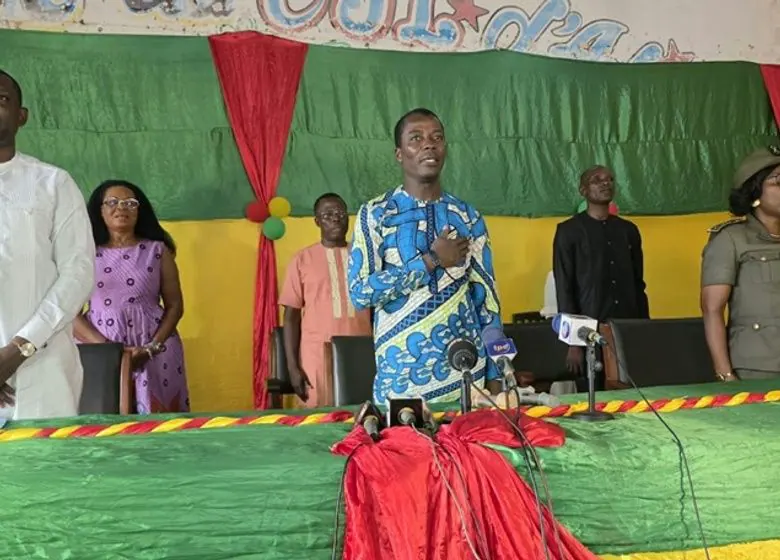
On Thursday, September 17, 2026, Benin's Minister of State and Government Spokesperson, Wilfried Léandre Houngbédji, led a government outreach initiative in Adjohoun, a town in the Ouémé region. The focus was on communicating government actions and measures aimed at improving daily life for local communities. To facilitate dialogue, Minister Houngbédji addressed the gathering in the local Goun language, underscoring the government's commitment to making public resource utilization explanations more relatable and tangible.
The event was officially opened by Prefect of Ouémé, Marie Akpotrossou, who encapsulated the meeting's spirit by stating that economic development is merely a means to achieve social progress and human fulfillment. This set the tone for Minister Houngbédji's presentation, which highlighted several key social measures. These included enhancing educational infrastructure and support for vulnerable groups. Notably, the government aims to achieve 100% coverage of school canteens in Adjohoun's primary schools and introduce free education for girls from kindergarten to high school.
In addition to educational initiatives, the government announced measures to support people with disabilities. These include the automatic allocation of university scholarships and free education for 5,000 students with disabilities. Furthermore, the government will provide subsidies for assistive devices and double the fund for supporting entrepreneurship among people with disabilities, increasing it from 200 million to 400 million FCFA. These measures reflect the government's broader commitment to inclusivity and social welfare.
The outreach also addressed concerns specific to the student community. Minister Houngbédji announced the deployment of 63 new buses starting Monday, September 21, to revitalize university transportation. Additionally, the government plans to revalue scholarships and allowances, modernize university restaurants and residences, and address other pressing student concerns. By engaging directly with students and the broader community, the government seeks to demonstrate its responsiveness to their needs.
Local issues also featured prominently in the discussions. Topics included the status of technical high schools, the situation of Aspirants to the teaching profession (AME), and the integration of teachers trained at the INJEPS. Moreover, concerns about outstanding payments to certain school canteen operators were raised. The local mayor brought up issues related to the region's connectivity, the establishment of a digital center, and challenges associated with climate resilience.
The government's social measures presentation was complemented by an open forum where community members could voice their concerns and expectations. This interactive session allowed for a two-way exchange, enabling the government to gather firsthand insights into local challenges and priorities. By doing so, the outreach initiative in Adjohoun reinforced the government's commitment to participatory governance and community engagement.
Ultimately, the Adjohoun leg of the government's outreach tour served as a platform for showcasing social initiatives and fostering a dialogue with local populations. Key points from the engagement include the emphasis on education, support for vulnerable groups, and infrastructure development. As the government continues its efforts to enhance the quality of life for Benin's citizens, such community engagements are crucial for ensuring that policies are responsive to local needs and concerns.
Key points
- The government aims to achieve 100% coverage of school canteens in Adjohoun's primary schools.
- Free education will be introduced for girls from kindergarten to high school.
- The fund for supporting entrepreneurship among people with disabilities will be doubled to 400 million FCFA.