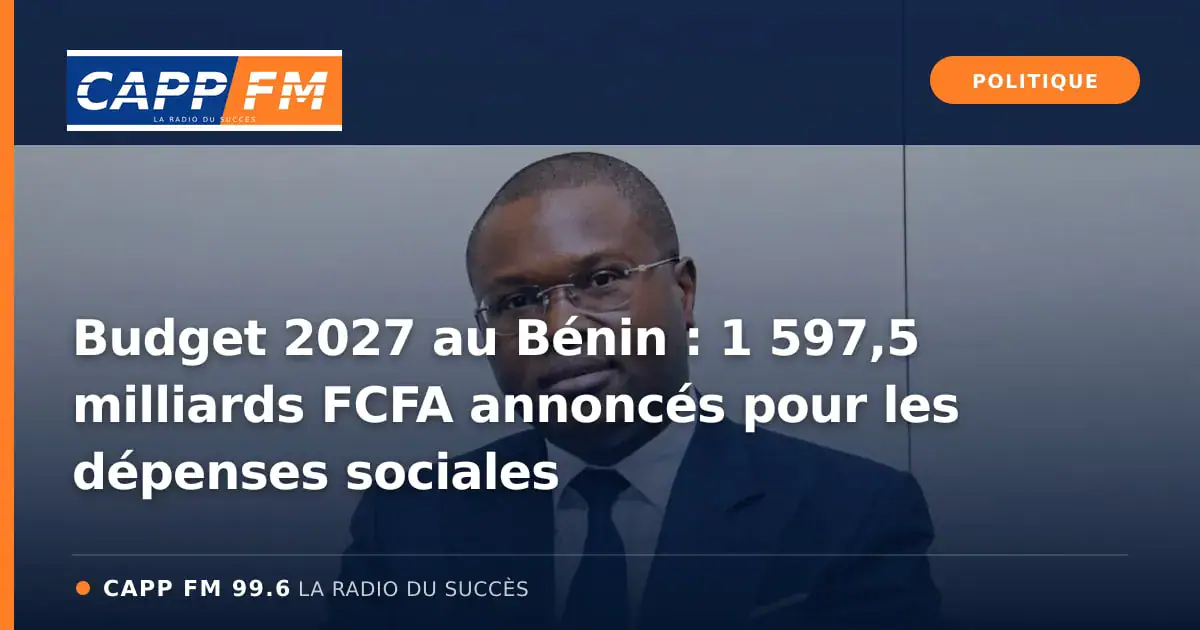
The government of Benin has presented its 2027 budget plan to the National Assembly's budget commission, outlining a total budget of 4,757.029 billion FCFA, representing a 14.7% increase from the 2026 revised finance law. The budget prioritizes social spending and public investments, with a focus on education, healthcare, and social protection. Finance Minister Aristide Mèdénou and his three deputy ministers presented the plan, highlighting key areas of focus.
The 2027 budget allocates 1,597.5 billion FCFA for social spending, up from 1,285.37 billion FCFA in 2026. This includes investments in education, such as extending the school meal program to cover 1.9 million students nationwide and maintaining free secondary and technical education for young girls. The government also plans to strengthen direct cash transfers to vulnerable populations and continue healthcare programs, including the Health Insurance for Human Capital Development (ARCH) and Gbéssoké.
The budget plan is based on macroeconomic projections, including a 7.5% growth rate, a 2.8% budget deficit, and an inflation rate of 2%, below the 3% threshold set by the West African Economic and Monetary Union (UEMOA). The government aims to finance 80% of the budget through its own resources, with 1,828 billion FCFA in revenue collected as of September 2026, representing a 66.8% realization rate.
The government plans to rationalize operating expenses to prioritize investments, with 1,545.2 billion FCFA allocated for public investment programs. This includes continued investments in the Glo-Djigbé Industrial Zone (GDIZ), as well as the development of sectors like tourism and digital technologies, including artificial intelligence. The budget also provides for the continuation of programs aimed at improving access to clean water and electricity.
The 2027 budget plan also focuses on modernizing agriculture, promoting industry, and valorizing the country's tourist and cultural potential. The government plans to deploy six territorial development poles, digitalize public spending, and integrate gender and climate considerations into budgetary choices. Additionally, the budget includes several tax exemptions to support economic activity, particularly for new vehicles, domestic gas, and equipment for small and medium-sized enterprises.
The government has introduced 14 new tax measures, including exemptions from value-added tax and customs duties on local e-commerce operations for transactions under 300,000 FCFA. The plan also simplifies land and digital taxation. For local authorities, the budget provides for strengthening financing mechanisms for territorial collectivities, through the operationalization of the Communal Investment Fund and the economic decentralization mechanism.
The 2027 budget plan will be subject to parliamentary examination before its expected adoption on December 8, 2026. If approved, the plan will guide Benin's economic and social development for the coming year, with a focus on improving living standards and promoting economic growth.
Key points
- The 2027 budget plan prioritizes social spending, with 1,597.5 billion FCFA allocated for education, healthcare, and social protection.
- The government aims to finance 80% of the budget through its own resources.
- The budget plan includes investments in infrastructure, industry, and digital technologies to promote economic growth.