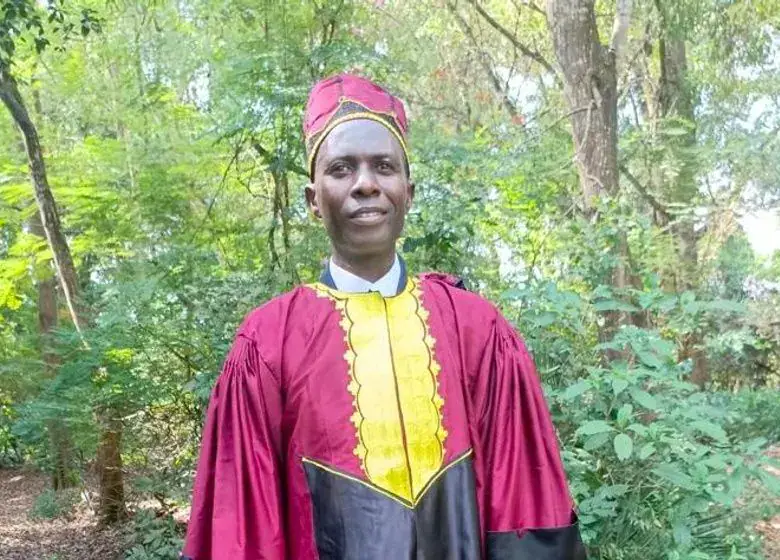
Aboudou Raïmi Essessinou has successfully defended his doctoral thesis, "La décision de vote au Bénin : analyse électorale et logiques mathématiques," at the University of Abomey-Calavi under the supervision of Professor Hygin Kakaï. The thesis explores the complexities of voter behavior in Benin, examining the factors that influence citizens' decisions to vote or abstain. Essessinou's research combines qualitative and quantitative methods, including statistical models and mathematical analysis, to provide a nuanced understanding of electoral dynamics in Benin.
The study is based on a comprehensive survey of 6,493 individuals across 3,320 households and 212 villages, covering all 24 electoral districts in Benin. The research also involved 52 focus groups and 153 individual interviews, as well as an analysis of six elections held between 2015 and 2023. Essessinou's findings reveal various voter profiles, including regular voters, occasional participants, and persistent abstentionists. The research highlights the significance of past electoral experiences in shaping future voting behavior.
According to Essessinou's research, the probability of participation varies across different types of elections. The estimated average probabilities of participation are 71.6% for presidential elections, 71% for legislative elections, and 67.2% for municipal elections. These differences reflect distinct logics and factors influencing voter behavior in each type of election. For instance, leadership and trust in institutions play a crucial role in presidential elections, while party affiliation and representation are more significant in legislative elections.
The thesis was evaluated by a multidisciplinary jury chaired by Alastaire Sèna Alinsato, a professor of economics at the University of Abomey-Calavi. The jury included experts from various fields, including sociology, anthropology, and mathematics. The examiners praised Essessinou's innovative approach, which combines insights from political science, economics, sociology, and mathematics to understand voter behavior. The jury awarded Essessinou a doctorate in political science with a "Très honorable" distinction and congratulations.
Essessinou's research has implications for political parties and public authorities in Benin. By understanding voter profiles, areas of low participation, and the factors driving abstention, policymakers can design more targeted awareness campaigns and evaluate the effectiveness of electoral reforms. The researcher notes that unmet socio-economic expectations and broken promises contribute to voter disillusionment. Essessinou's work aims to contribute to a deeper understanding of Beninese democracy, highlighting the complexities of voter decision-making.
Aboudou Raïmi Essessinou is a statistician-economist by training, with degrees from the ENSEA in Abidjan and several diplomas in mathematics, finance, and political science. Since February 2022, he has headed the national accounting and economic statistics department at the INStaD. This academic achievement adds to his diverse career, which spans public administration, statistical production, and research.
Essessinou's study provides new insights into the dynamics of voter behavior in Benin, emphasizing that each vote or abstention reflects a deliberate decision influenced by various social, political, economic, and institutional factors. His research underscores the need for a nuanced understanding of electoral behavior, beyond simple dichotomies between voters and abstentionists.
Key points
- The research highlights the significance of past electoral experiences in shaping future voting behavior.
- The study reveals various voter profiles, including regular voters, occasional participants, and persistent abstentionists.
- The research has implications for political parties and public authorities in Benin, suggesting ways to improve voter engagement and electoral reforms.