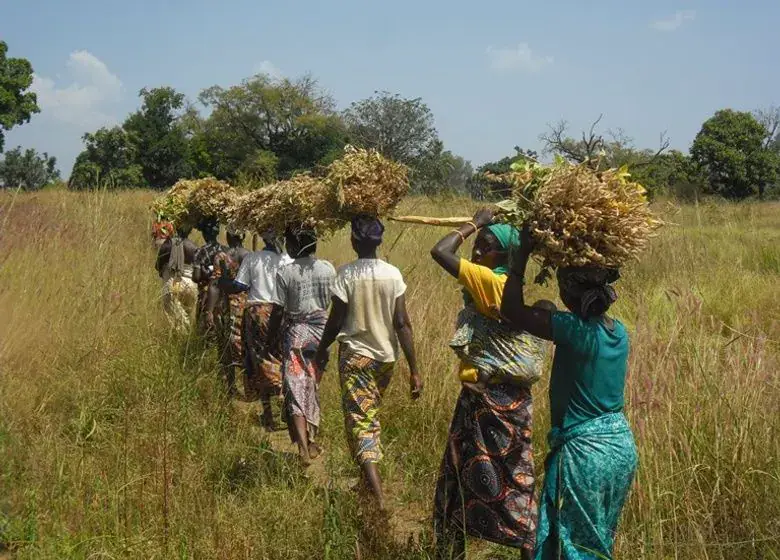
A thesis by Obossou Hypolite Ezin, defended on October 20, 2026, at the University of Parakou, has shed light on the paradox of rural women's substantial contributions to agriculture in northern Benin, despite their limited involvement in strategic decision-making. The research, conducted under the supervision of Professor Yvette Onibon Doubogan, found that women play a crucial role in farming activities, including sowing, harvesting, and processing agricultural products, as well as managing most domestic tasks. However, they remain largely excluded from strategic decision-making in family farms.
The study, which surveyed 510 family farms and analyzed data from 371 households and 837 individuals, revealed that men hold 99.2% of land ownership in the studied households. Additionally, men make most decisions related to credit, with women having limited access to resources and decision-making power. The research also found that women's participation in organizations does not necessarily guarantee their influence, with only 21.2% of women members reporting that they participate in all decisions within their organizations.
The thesis used the Women's Empowerment in Agriculture Index (WEAI) to measure women's autonomy in agriculture. The results showed an improvement in women's empowerment between 2015 and 2018, with the global index increasing from 0.370 to 0.574. However, 86.71% of women still exhibit inadequacies in the measured domains, and 78.76% of households do not achieve gender parity. The study also found that women in the cotton-growing area have a higher empowerment index than those in the food crop-growing area.
The research highlighted the significant workload borne by women, who dedicate around 15 hours a day to agricultural and domestic activities. This heavy workload limits their availability for collective activities and access to leadership positions. The study concluded that women's autonomy in agriculture is still incomplete, and that policies should focus on addressing the social norms, informal power structures, and real transformations in women's status.
The thesis recommended that policies aimed at promoting women's empowerment in agriculture should focus on providing equal access to land and financing, reducing domestic tasks, strengthening women's leadership, and raising awareness about gender inequalities. The researcher also suggested adapting measurement tools to local realities and combining quantitative and qualitative data to better understand the complexities of women's empowerment in agriculture.
The study's findings have implications for policymakers and development practitioners seeking to promote women's empowerment in agriculture. The researcher emphasized that increasing women's participation in agriculture is not enough to guarantee their autonomy; rather, it is essential to address the underlying structural barriers that limit their access to resources, decision-making power, and leadership positions.
The thesis was supervised by Professor Yvette Onibon Doubogan and examined by a jury of experts in sociology, agroforestry, and gender and rural development. The candidate was awarded a doctorate in sociology with a "Very Honorable" mention. The research contributes to the ongoing debate on women's empowerment in agriculture and highlights the need for a more nuanced understanding of the complex factors influencing women's autonomy in rural areas.
Key points
- Women's significant agricultural contributions in northern Benin are not matched by their involvement in strategic decision-making in family farms.
- The study recommends policies that address social norms, informal power structures, and real transformations in women's status to promote their empowerment in agriculture.
- The research highlights the need for a more nuanced understanding of the complex factors influencing women's autonomy in rural areas.