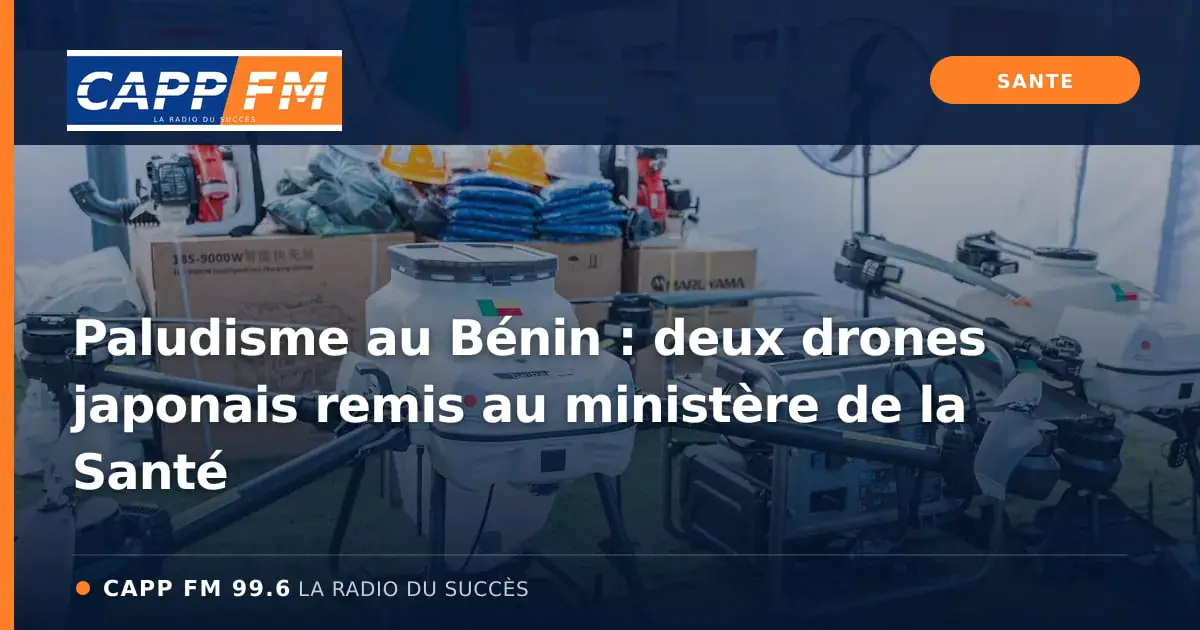
The Beninese Ministry of Health has received two drones and 12 backpack sprayers from Japan to enhance malaria control efforts in the country. The equipment, valued at $2.3 million, was handed over in Cotonou on November 26, 2026. The drones, model TSUBASA CT110, and sprayers, model Maruyama MD300, are part of a project aimed at reducing mosquito populations that transmit malaria.
The project, titled "Integrated Action for Malaria Prevention: Public-Private Partnership and Local Youth Engagement," is funded by the Japanese government and technically supported by SORA Technology and UNICEF. It adopts a comprehensive approach combining digital tools, larval habitat treatment, and community mobilization. The initiative targets 10 pilot districts, with interventions in Tchaourou, Djougou, and Copargo in the north, and Godomey, Avlékété, Djègbadji, Ouidah 1, Ouidah 2, Ouidah 4, and the 12th arrondissement of Cotonou in the south.
The drones will facilitate spraying operations in targeted areas, while the backpack sprayers will be used for manual interventions. The project, launched on June 30, 2026, has a 12-month pilot phase scheduled from March 2026 to February 2027. Japanese Ambassador to Benin, Hideki Uezono, stated that the resources mobilized come from a supplementary budget related to the 9th Tokyo International Conference on African Development (TICAD 9) held in 2025.
Ambassador Uezono emphasized that the cooperation aims to combine Japanese technology and expertise with local knowledge and solutions. UNICEF representative, Ousmane Niang, reported that initial project results show a significant reduction in larval density in targeted areas, demonstrating the potential of new technologies to accelerate malaria control progress.
Health Minister Benjamin Hounkpatin expressed gratitude to partners and assured that his department will ensure the proper use of the equipment to achieve desired outcomes. He highlighted that the health of populations, particularly children and pregnant women, is crucial for sustainable development.
Malaria remains a significant burden in Benin, with preventable diseases, including malaria, continuing to affect families' daily lives. The minister stressed the importance of effective interventions to combat the disease.
The project aims to strengthen malaria control efforts in Benin, leveraging innovative technologies and community engagement to reduce the disease's impact on the population.
Key points
- The project combines digital tools, larval habitat treatment, and community mobilization to combat malaria in 10 pilot districts.
- The equipment, valued at $2.3 million, includes two drones and 12 backpack sprayers.
- The 12-month pilot phase is scheduled from March 2026 to February 2027.