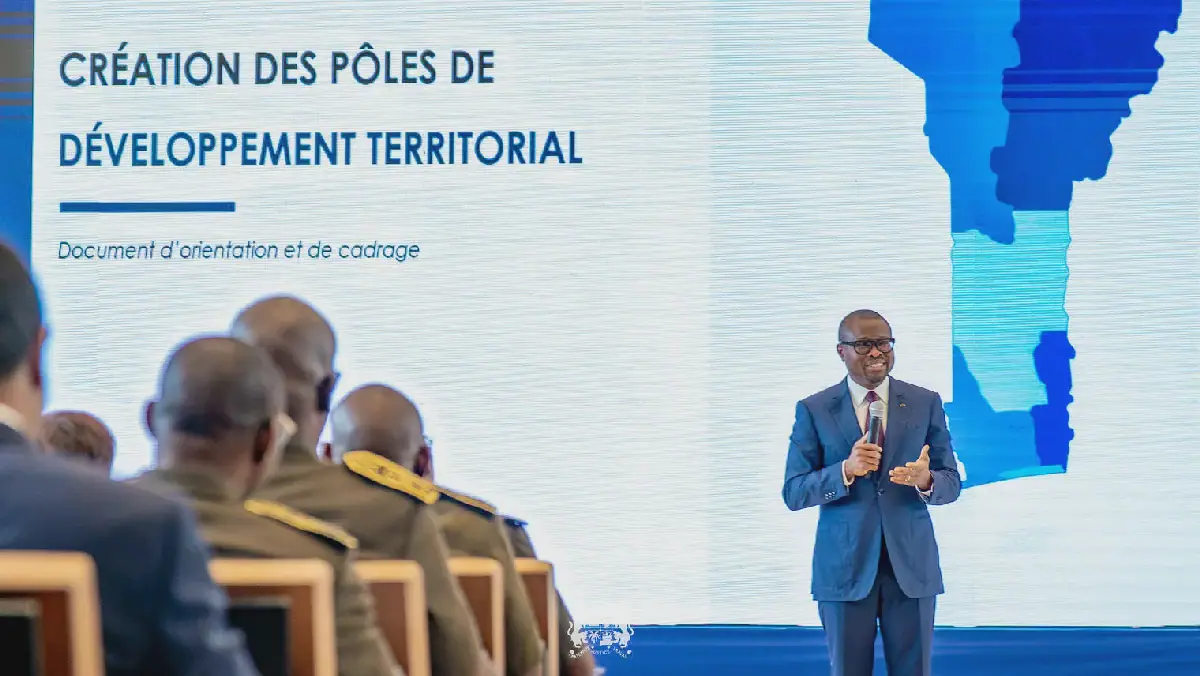
The Benin government has introduced a new strategy to tackle poverty and distribute economic growth more evenly across the country. Despite sustained economic growth, the country's poverty levels remain a major concern. According to the World Bank, 39.4% of the population is expected to live below the international poverty line of $4.20 per day in 2026. To address this, the government has created six territorial development poles and a new action program that prioritizes the eradication of extreme poverty.
The six development poles, which include Nord-Est, Nord-Ouest, Centre, Sud-Est, Sud-Ouest, and Grand-Nokoué, aim to valorize the economic potential of each commune and organize local development around four key areas: agriculture, tourism, industry, and innovation. The program will be implemented in four stages, with the first stage focusing on the installation of governance structures and the conduct of economic and territorial diagnostics. The subsequent stages will involve identifying priority sectors, infrastructure needs, and competencies, as well as developing a portfolio of public and private projects.
The government's Program of Action (Pag) 2026-2033, approved on November 4, 2026, places the eradication of extreme poverty among its top priorities, alongside expanding the productive base and economic opportunities, and strengthening governance, national cohesion, and security. The program aims to transform economic performance into income, jobs, and accessible services for all populations, regardless of their place of residence. The government has set an ambitious target of achieving an average real growth rate of 7.7% over the period.
Despite progress in reducing poverty, significant disparities persist across territories. According to the National Institute of Statistics and Demography (Instad), the incidence of monetary poverty decreased from 38.5% in 2019 to 36.2% in 2022. However, poverty remains a major challenge in rural areas, affecting 40.6% of the population in 2022, compared to 30.8% in urban areas. The new territorial development poles and action program aim to address these disparities and promote more inclusive growth.
The government has also established a social protection system to support vulnerable populations. The Unique Social Register (Rsu), managed by the National Social Protection Agency (Anps), identifies and targets households according to their poverty level. The Arch program, which includes a health insurance component, provides comprehensive coverage for extreme poor households and a 50% subsidy for non-extreme poor households. Additionally, the Gbessoké program provides cash transfers to households in extreme poverty to support the development of income-generating activities.
The government's efforts to tackle poverty will require significant financial resources. The 2027 budget bill provides for 1,597.53 billion F CFA in social spending, up 24.3% from 2026. These resources will support the continuation and extension of the Arch program, cash transfers, school canteens, and various health and education interventions. The effectiveness of these efforts will depend on their implementation, targeting, and ability to produce sustainable results.
The third edition of the Harmonized Survey on Household Living Conditions (Ehcvm) is expected to provide new data on poverty and living conditions. The survey, conducted in two waves between November 2025 and July 2026, will update indicators on income, consumption, and living conditions, as well as territorial disparities. The results will inform the government's poverty reduction strategies and help assess the impact of its programs.
Key points
- The Benin government has introduced six territorial development poles and a new action program to eradicate extreme poverty and distribute economic growth more evenly.
- The program aims to achieve an average real growth rate of 7.7% over the period 2026-2033.
- The government has established a social protection system to support vulnerable populations, including the Unique Social Register and the Arch program.