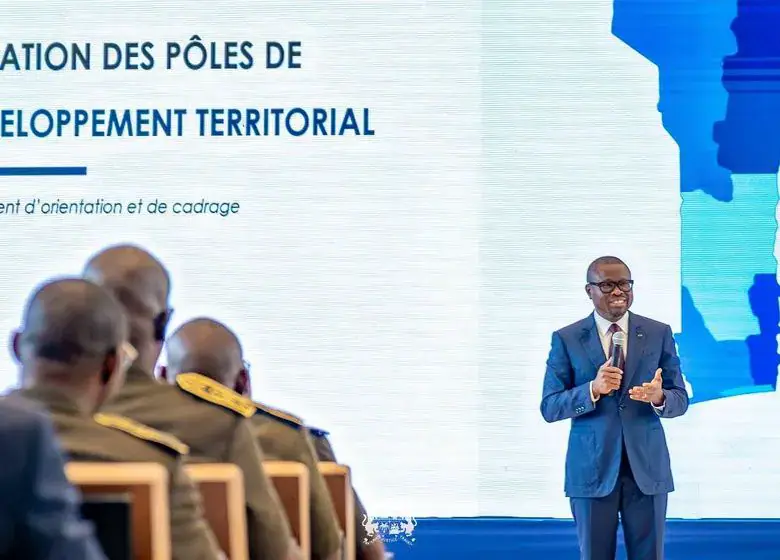
The Beninese government has presented a reform to develop territorial poles, a central concept in its seven-year program aimed at strengthening public action efficiency and accelerating development. The reform was introduced to prefects and mayors during a meeting on September 23, 2026. The government's approach focuses on three major priorities: reducing extreme poverty, developing human capital, and creating wealth at the grassroots level.
The new organization will be based on territorial poles under the responsibility of General Delegates. Their performance will be evaluated based on specific criteria. These delegates will be tasked with closely monitoring local realities and ensuring the effectiveness of programs benefiting farmers, breeders, fishermen, and other vulnerable populations. The government's goal is to strengthen the state's presence across the territory.
President Romuald Wadagni emphasized the need for a stronger state presence and cadres in the territories. He instructed General Delegates to reside in their poles, regularly visit the field, and report difficulties and progress to their hierarchy. This proximity aims to enhance security by addressing vulnerabilities that may expose young people to the influence of criminal or armed organizations.
The President called on high-ranking officials to take an interest in their regions and villages of origin and contribute to their development. He advocated for a change in behavior, urging local authorities to adopt a "zero tolerance" policy towards incivility, waste, and indiscipline. Wadagni encouraged mayors, prefects, and local officials to be exemplary, pedagogical, and individually responsible.
The government's ambition is to make each commune a clean, organized, and attractive space, particularly by improving city entrances and public areas. The reform on territorial pole development was an electoral promise by President Wadagni, who vowed to establish a new dynamic of public action divided into six regional development poles.
The six regional poles are Atacora-Donga, Borgou-Alibori, Zou-Collines, Ouémé-Plateau, and Atlantique-Littoral. Each pole will have a specific development plan, taking into account the ecosystem, assets, and know-how of the region. The President's project, "Plus loin, ensemble," presented on March 21, 2026, outlined the creation of authorities for each region and a common foundation to facilitate and accelerate objective achievement.
The presentation ceremony for the territorial pole development reform brought together the President of the National Assembly, members of the Economic and Social Council (CES), prefects, mayors of the 77 communes, and government members. Four months after his election, President Wadagni has made this electoral promise a reality.
Key points
- The Beninese government has launched a reform to develop territorial poles, aiming to enhance public action efficiency and accelerate development closer to the population.
- The reform focuses on three major priorities: reducing extreme poverty, developing human capital, and creating wealth at the grassroots level.
- The new organization will be based on territorial poles under the responsibility of General Delegates, who will be tasked with closely monitoring local realities and ensuring program effectiveness.