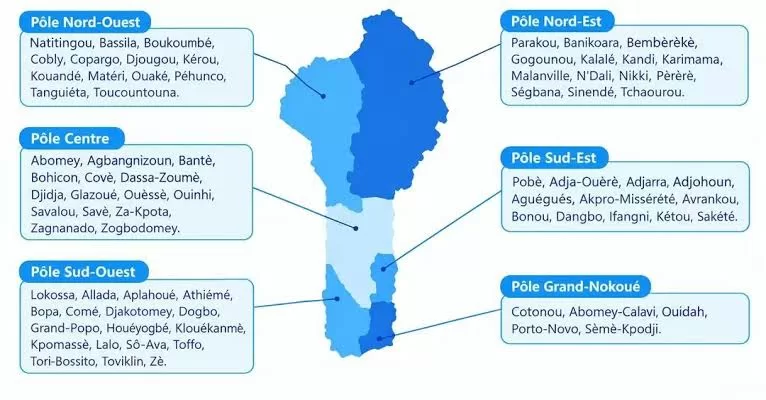
The government of Benin has taken a significant step towards achieving balanced development by approving the creation and organization of six territorial development poles. This move, adopted by the Council of Ministers on October 7, 2026, under the presidency of Head of State Romuald Wadagni, aims to better utilize the potential of the country's various communes and accelerate national development.
The new approach focuses on territorializing public action by grouping communes with similar characteristics and assets to foster economic dynamics tailored to each territory's realities. The six poles will cover the country's 77 communes, categorized into Nord-Est, Nord-Ouest, Centre, Sud-Est, Sud-Ouest, and Grand-Nokoué. Each pole will have its unique strengths, with Nord-Est including Parakou, Kandi, and Malanville, while Nord-Ouest will comprise Natitingou, Djougou, and Tanguiéta, among others.
The development poles will focus on four main areas: agriculture, tourism, industry, and innovation. By identifying priority sectors, infrastructure needs, and required skills, each territory aims to become a growth hub, stimulate investment, and create jobs. The government has outlined a four-phase plan to operationalize the reform, starting with the installation of governance bodies and the nomination of Delegated General from October to December 2026.
The second phase, from January to March 2027, will see each pole define its growth drivers, priority sectors, and needs, as well as identify projects to enhance its attractiveness. The third phase, from April to June 2027, will focus on finalizing operational roadmaps and allocating responsibilities among the state, communes, and the private sector.
By July to December 2027, priority projects and rapid actions will be initiated, with a monitoring and evaluation system in place. A National Steering Committee, chaired by the Head of State, will oversee the process, supported by a Permanent Secretariat. Each pole will have a delegation led by a Delegate General, assisted by mission officers, experts, and support staff.
The government aims to leverage the unique strengths of each territory to drive development, investment, and improved living conditions. This reform seeks to address regional disparities and promote sustainable growth by empowering local communities and encouraging private sector participation.
With the implementation of the six development poles, Benin is poised to unlock its growth potential, enhance regional development, and improve the quality of life for its citizens. The success of this initiative will depend on effective coordination, stakeholder engagement, and careful monitoring of progress.
Key points
- The creation of six territorial development poles aims to promote balanced growth and harness local potential in Benin.
- The development poles will focus on agriculture, tourism, industry, and innovation to drive growth and job creation.
- A four-phase plan has been outlined to operationalize the reform, with a National Steering Committee overseeing the process.