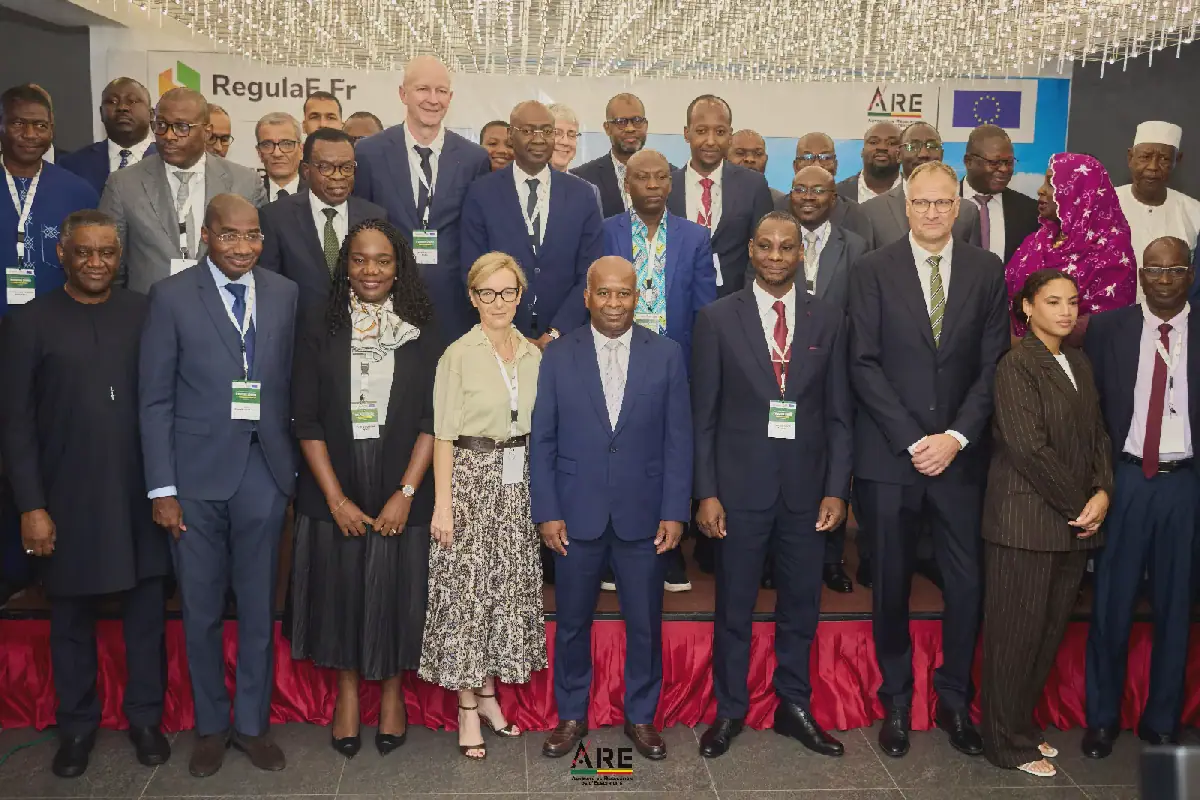
The Beninese capital, Cotonou, is hosting the 18th workshop and 9th general assembly of the Francophone Network of Energy Regulators (RegulaE.Fr) from November 23 to 26. The event brings together regulators from Francophone countries to discuss the necessary conditions to attract more investments in the energy sector. This meeting coincides with the 10th anniversary of RegulaE.Fr's creation.
RegulaE.Fr was established in Paris on November 28, 2016, as an initiative of the French Energy Regulatory Commission (CRE), in collaboration with the Ivorian National Electricity Regulatory Authority (ANARE-CI), the Belgian Electricity and Gas Regulatory Commission (CREG), and the Quebec Energy Board. Today, the network comprises 37 members from Africa, Europe, North America, and the Asia-Pacific region.
The President of the Beninese Electricity Regulatory Authority (Are), Émeric Tokoudagba, highlighted that the network has become a genuine community of peers over the past decade, united by their conviction that effective regulation is best achieved through collaboration. Francis Ketiboah-Aka, representative of RegulaE.Fr's president, echoed this sentiment, emphasizing the importance of cooperation and knowledge sharing in addressing sector challenges.
The central theme of the meeting focuses on mobilizing investments in a rapidly changing energy sector. Discussions will cover key investment needs, major constraints limiting financing, and the regulatory framework required to attract sustainable investments. According to Edouard Dahome, Benin's Minister of Energy, Water, and Mines, energy is a crucial factor in economic and social development, and reliable access to energy is essential for sustaining industrialization and improving living standards.
However, access to energy remains a significant challenge in several countries, and public resources alone will not be sufficient to finance the necessary infrastructure. Dahome emphasized that the question is not how much to invest, but rather how to create conditions that facilitate investment. The European Union's representative in Benin, Christian Frigaard Rasmussen, also stressed the magnitude of the challenge, highlighting the need for strong political commitment, effective reforms, and a list of priority projects to attract local and international capital.
RegulaE.Fr promotes capacity building, knowledge sharing, and technical cooperation among its members. One of its initiatives is the Energy Regulation Aptitude Certificate (Badge) program, which offers high-level training to energy sector professionals in Francophone Africa. The program, developed with the Paris School of Mines and its partners, has supported beneficiaries who presented their projects during the event.
As RegulaE.Fr marks its 10th anniversary, its members are looking ahead to the next decade, with a focus on priorities and challenges such as energy pricing, investment mobilization, and renewable energy development. The organization's goal is to remain a platform for exchange and concrete action, translating its work into effective regulatory policies and practices.
Key points
- The 10th anniversary of RegulaE.Fr highlights the importance of cooperation and knowledge sharing in addressing energy sector challenges.
- The organization brings together 37 members from Africa, Europe, North America, and the Asia-Pacific region to discuss investment mobilization and sector development.
- The Beninese capital hosts the 18th workshop and 9th general assembly of RegulaE.Fr from November 23 to 26.
Reporting sources
- Régulation énergétique : RegulaE.Fr fête 10 ans et prépare l’avenir · Bénin Intelligent