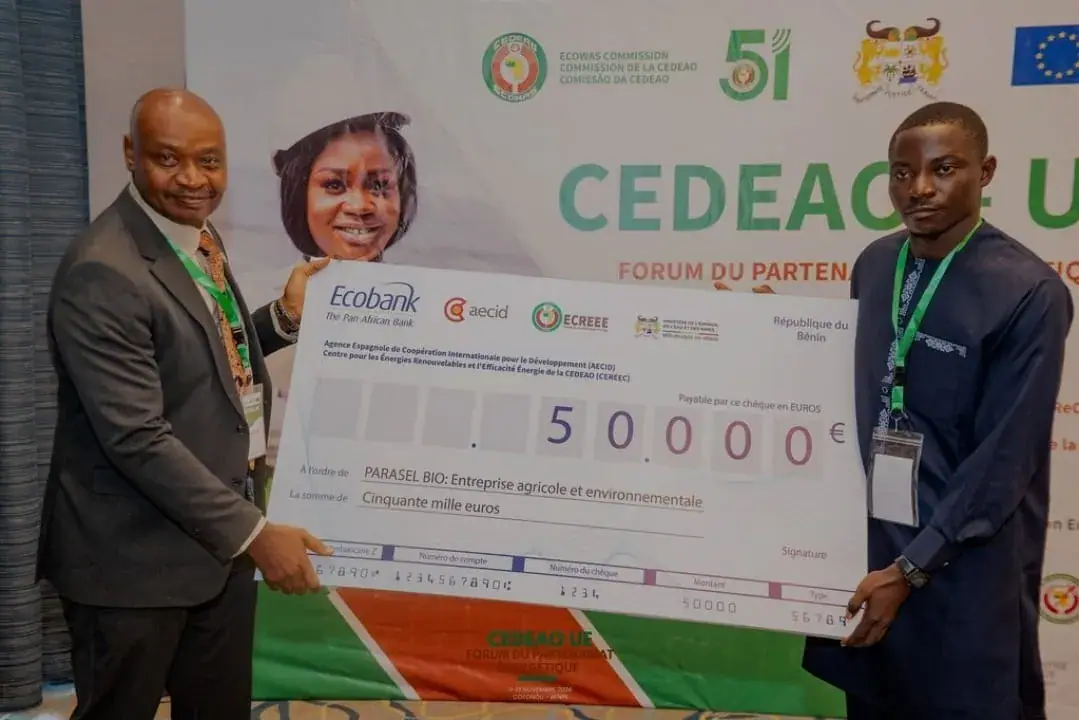
The three initiatives were recognized on November 12, 2026, during the Cedeao-Ue Energy Partnership Forum 2026 in Cotonou, Benin. They aim to transform agricultural waste into energy resources and useful products for economic activities. The awarded projects focus on producing biogas from pineapple and cassava waste, as well as manufacturing ecological charcoal.
The Association for Development Initiatives (Apid), represented by Edmond Tossa, will use the funding to reduce the energy dependence of pineapple processing units. The project involves converting pineapple residues into biogas to power processing units, with plans to install a 30 cubic meter biodigester and a 30 kilowatt solar system in Allada. This initiative is expected to benefit 80 direct beneficiaries, including 50 women, and 300 indirect beneficiaries, while generating 15 green jobs.
Parasel-Bio, led by Mario Ezin, will work on valorizing cassava transformation residues. The project combines biogas production with the creation of biological fertilizers to limit agricultural losses and generate new revenue streams. The initiative also plans to extend its solution to electricity production for a locality with insufficient energy supply. The project is expected to indirectly benefit around 1,200 people through the valorization and commercialization of cassava-derived products.
Adjiyon, led by Arnaud Sènadé Bonou, will focus on strengthening ecological charcoal production from agricultural residues. The funding will be used to acquire equipment to increase production capacity, relying on a network of around 300 collectors and suppliers of agricultural waste. The goal is to develop the distribution of this alternative to traditional charcoal and expand the number of households using it.
These three initiatives are part of the Regional Pilot Project on Circular Economy (Rpce), implemented by the Regional Center for Renewable Energies and Energy Efficiency (Cereec), with support from the European Union and the Spanish Cooperation Agency. The program provides non-repayable subsidies in the form of co-financing, targeting four sectors in Benin: cashew, cassava, pineapple, and palm oil.
The projects will contribute to the country's transition to renewable energy and the valorization of local resources. The challenge now is to concretize the announced investments and measure their impact on beneficiary structures, producers, and concerned communities. The initiatives will help reduce energy expenses, create new revenue streams, and promote sustainable development in Benin.
Key points
- Three Beninese initiatives received 50,000 euros each for their innovative projects on agricultural waste valorization and circular economy.
- The projects aim to transform agricultural waste into energy resources and useful products for economic activities.
- The initiatives will contribute to the country's transition to renewable energy and the valorization of local resources.