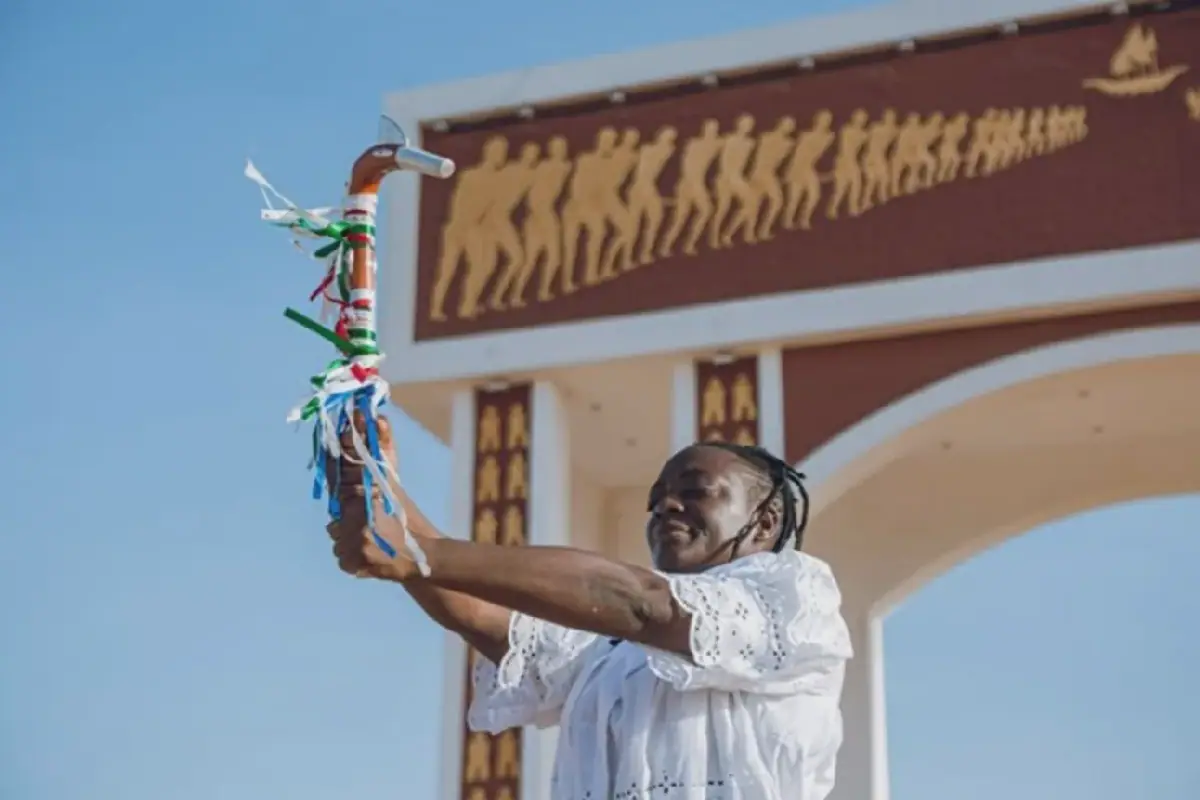
On the shores of Ouidah's Porte du Non-Retour beach, artist Sika da Silveira has created a performance titled "Racines croisées : le retour" (Crossed Roots: The Return). This artistic gesture brings together two sides of the Atlantic, using art to bridge the distance between Benin and Brazil. The performance features music and percussion, evoking the history of the transatlantic slave trade and the memories that linger.
The project began in August 2025 in Salvador de Bahia, Brazil, where Sika da Silveira was a resident artist. She became interested in transatlantic memories and their impact on the identities of Afro-descendants. The artist discovered a tradition in which devotees tie ribbons to their wrists or grids, making vows to their deities. Sika invited Afro-descendants to write their aspirations on these ribbons, which she then tied to a ceremonial object called a récade, symbolizing the power and speech of the ancient Kingdom of Dahomey.
The récade, adorned with ribbons, traveled from Brazil to Benin, where it was presented on the beach at Porte du Non-Retour. This site holds significant historical importance, as it was a major departure point for enslaved Africans sent to the Americas. By bringing the récade back to its ancestral homeland, Sika da Silveira aimed to symbolically reverse the transatlantic journey and reconnect the Afro-descendant community with their roots.
The performance in Ouidah is not an isolated event but part of a larger artistic and cultural program called Eco da Bahia. The project aims to explore and celebrate Afro-Atlantic heritage through various artistic expressions, including sculpture, painting, drawing, and installation. An exhibition is planned as a follow-up to the performance, featuring works created during Sika's residency in Bahia.
According to the project's curator, the restitution of vows in Benin is a natural continuation of the initial experience in Brazil. He emphasizes the importance of sharing and giving a platform to the voices of Afro-descendants, who have been forcibly separated from their homeland. By doing so, the project seeks to highlight the connections between African and Afro-Brazilian cultures.
The "Racines croisées : le retour" performance also underscores the significance of intangible cultural heritage, which is transmitted through daily practices, food, gestures, and spiritual expressions. These traditions, though transformed over time, retain elements of their origins and continue to shape the identities of Afro-descendants.
As the récade, adorned with ribbons, completes its symbolic journey, it embodies the voices and vows of those who were forcibly taken from their homeland. The performance serves as a poignant reminder that oceanic boundaries cannot erase cultural belonging and that identities can survive forced displacement.
Key points
- Artist Sika da Silveira brings vows from Afro-descendants in Bahia, Brazil, back to Benin, exploring transatlantic memories and identities.