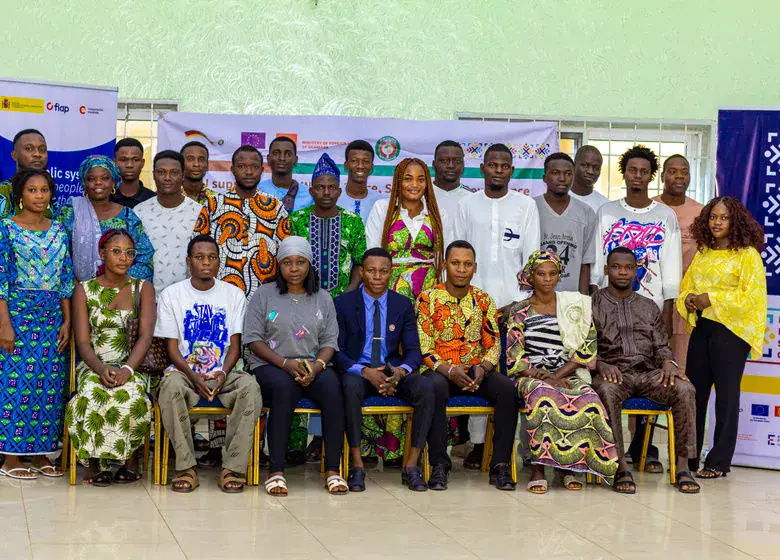
The FIAP, in collaboration with BANOUTO, organized a three-day training workshop in Parakou, Benin, from November 9 to 11, 2026. The workshop aimed to strengthen the capacities of 25 journalists, radio hosts, and community relays to identify, verify, and counter false or misleading information in local languages. This initiative is part of the EPSG project, supported by the European Union, to promote peace, security, and governance in West Africa.
The training focused on the importance of local languages in accessing information, particularly in communities where radio, social media, and interpersonal exchanges are primary communication channels. Participants learned to verify content, use digital tools and artificial intelligence with discernment, and adapt their findings to the linguistic and sociocultural realities of their audiences. They also developed strategies to address misinformation circulating offline, prioritizing dialogue and social cohesion.
The workshop covered various modules, including "Understanding Misinformation in Local Languages, Risks, and Consequences." Facilitator Judicaël Kpèhoun, a journalist specializing in combating misinformation, led the sessions. Participants distinguished between disinformation, which involves intentionally spreading false information, and misinformation, which is sharing false information without intending to deceive. They also discussed the periods when misinformation is more likely to spread, such as during elections, health crises, and social tensions.
Participants engaged in practical exercises to identify different forms of misinformation, including manipulated images and videos, out-of-context content, and identity usurpation. They learned to examine three essential elements before believing or sharing a publication: its form, content, and source. The facilitators recommended paying attention to errors, alarmist messages, inconsistencies, and the credibility of the author.
The training also covered the use of digital tools and artificial intelligence in verifying suspicious content. Participants learned about Google Lens and other methods for searching the origin of an image. Christian Hounnongbè, a trainer in artificial intelligence, presented a communication on avoiding the pitfalls of misinformation when using AI. He highlighted the limitations of AI, which can generate inaccurate or invented information.
The workshop was part of the EPSG project, implemented by FIAP and BANOUTO, and co-financed by the European Union, the German Federal Ministry for Economic Cooperation and Development, and the Danish Ministry of Foreign Affairs. The FIAP is currently implementing the third component of the EPSG project in West Africa, in partnership with the German Development Cooperation (GIZ).
The training equipped participants with the skills and knowledge to identify and counter misinformation in local languages, promoting peace and social cohesion in their communities. Key points include:
Key points
- The training workshop was attended by 25 journalists and local information actors.
- Participants learned to verify content, use digital tools and artificial intelligence with discernment.
- The initiative is part of the EPSG project, supported by the European Union.