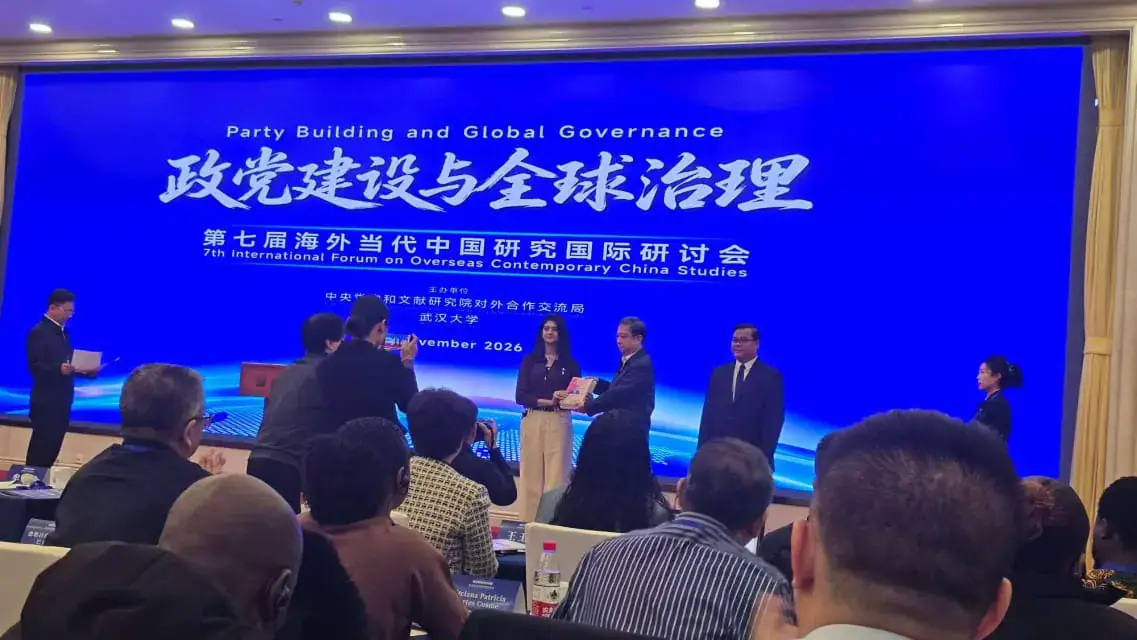
The seventh International Forum for Contemporary Chinese Studies Abroad was held in Beijing, bringing together experts, researchers, academics, and media professionals from various countries. The forum, organized by the Institute of History and Literature of the Communist Party of China and Wuhan University, focused on the relationship between party building and global governance. The discussions provided a platform for exchanging views on public administration and China's experience in institution-building.
Dr. Labna Yunes, a researcher in international law and founder of the "Sama News Agency," presented a paper titled "Media and the Rule of Law - A Bridge between Party Building and Global Governance." She emphasized that governance is not only created in large halls but also tested in daily practices. Yunes cited the example of a journalist facing breaking news and having to choose between being the first to report and verifying the information.
Yunes highlighted the connection between party building and global governance as institutionalization, which involves clear rules, responsibility, and continuity. She referenced the Chinese white paper on global governance, released on June 17, 2026, which warns against the law of the jungle undermining the rule of law internationally. Yunes outlined three primary functions of the media: translating complex legal and political concepts into understandable language, monitoring the implementation of rules, and building a cultural bridge between nations.
Ibraheem Al-Dahara, a Yemeni writer and journalist, presented a paper titled "China's Constructive Role in a More Just World: Yemen's Experience with Governance." He questioned what global governance has provided for countries in the Global South, citing Yemen's situation as an example. Al-Dahara noted that despite its strategic location, Yemen lacks a seat in the governance hall, resulting in over 22 million people needing humanitarian assistance.
Al-Dahara attributed Yemen's situation to internal weakness and external interference seeking influence and resources. In contrast, he discussed China's experience, which emphasizes shared governance, respect for national sovereignty, and the implementation of its initiatives on global governance and development. Al-Dahara cited China's progress in infrastructure development and poverty reduction, with over 800 million people lifted out of poverty since economic reforms.
The forum provided a platform for participants to share their perspectives on global governance, with a focus on the role of media and the Global South. The discussions highlighted the need for a more equitable and just global governance system. Participants also explored ways to enhance cooperation and understanding between nations, particularly between China and Africa.
The event concluded with a call to consider global governance from the perspective of developing countries, such as Yemen, which faces significant challenges. The discussions emphasized the importance of implementing laws and regulations, as well as promoting a culture of accountability and transparency. The forum demonstrated the growing interest in exploring new approaches to global governance that prioritize cooperation, equity, and justice.
Key points
- The forum highlighted the crucial role of media in shaping global governance and promoting a more equitable international order.
Reporting sources
- حوار حول الحوكمة في بكين يضع الإعلام والجنوب في الواجهة! · echoroukonline.com