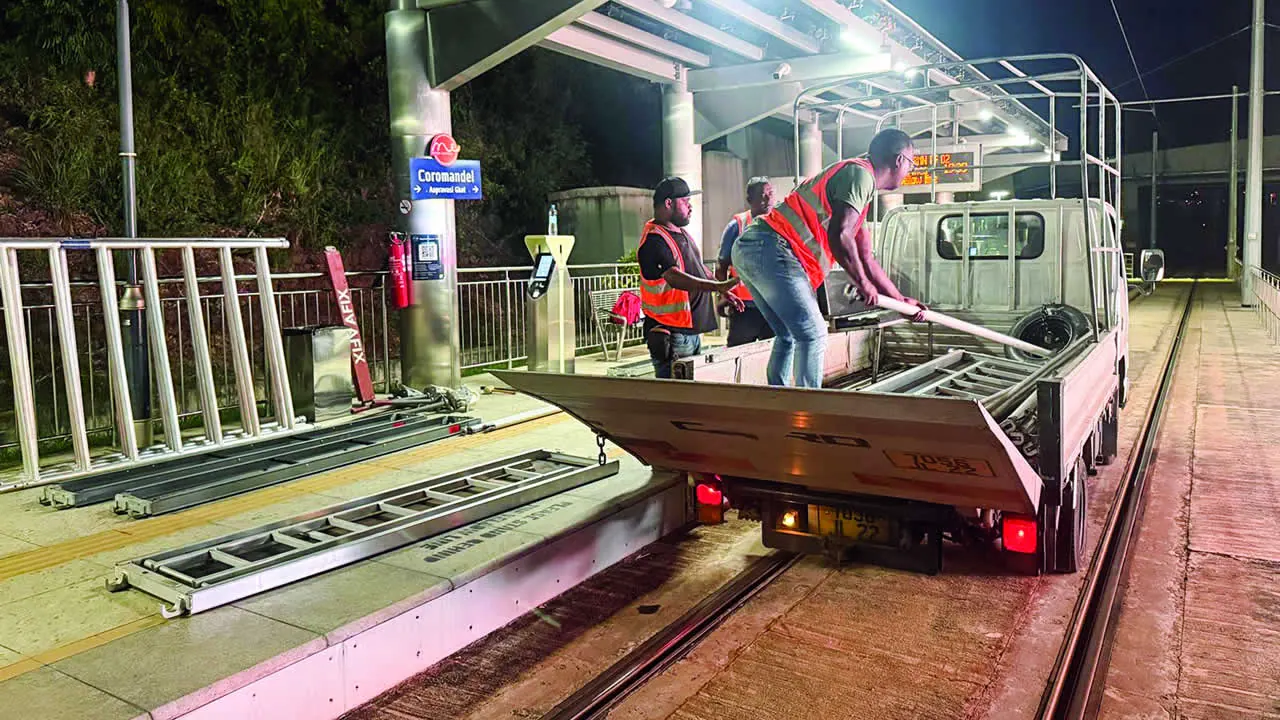
As the last passengers leave the trams at 8 pm, the night shift begins at the Richelieu depot. The 18 trams gradually return, some for cleaning and disinfection, while others head to the technicians for maintenance. Moorooghen Chinapen, responsible for maintenance, coordinates a team of around 40 people who work in shifts to ensure the trams are in good working condition. The maintenance work is done on a rotational basis, 24/7, to avoid disrupting the service.
The maintenance team's work is not limited to the trams; they also inspect and maintain the rails, overhead wires, signaling systems, lighting, drains, and vegetation around the stations and along the route. The tram's metal wheels can be "reprofiled" to ensure they remain properly calibrated. Every aspect of the network's functioning is checked and maintained by the team. Specialized equipment, such as machines to straighten rails and overhead wires, rescue vehicles, and tamping machines, are used for specific operations.
Each intervention requires a permit, including the "Special Permit" and a "risk assessment". The team works efficiently to complete the maintenance tasks, with the first "certificates of fitness" being issued around 1 or 2 am and the last ones by 3 am. Before a tram can rejoin the network, it must pass two inspections: one by the "rolling stock" team and another by the "Train Captain". These daily inspections ensure the trams are in good working condition.
In addition to the maintenance work, the network is also monitored from the Operation Command Centre (OCC). A team of around 10 operators, along with a police officer, monitor the metro's activity, and 400 cameras installed throughout the network provide real-time footage. The OCC team responds to incidents and technical faults, and works with the maintenance team to resolve issues quickly.
Despite the surveillance, incidents still occur, including the theft of electrical cables, which can cause significant disruptions. The cables are constantly under tension, and to prevent theft, Metro Express Ltd (MEL) is replacing copper with aluminum and considering modifying certain structures. The company also faces challenges in identifying perpetrators, as they often wear masks, making it difficult to identify them from camera footage.
Vandalism is a significant concern, with equipment being damaged or stolen, causing delays and disruptions. MEL has installed new locks on affected equipment and increased the frequency of machine emptying. The company estimates that a single act of vandalism can cost millions of rupees, not just in terms of repair costs but also in terms of delayed maintenance and repairs. The impact of vandalism is not limited to the financial cost; it also affects passengers and technicians.
MEL is exploring new technologies, including artificial intelligence and the Internet of Things, to enhance surveillance and prevent incidents. The company aims to acquire new equipment with sensors that can collect and transmit data in real-time. With a service operational reliability of 99.9% since its launch, MEL continues to work on improving its services, with a focus on prevention and efficient maintenance.
Key points
- The Metro Express network in Mauritius operates a 24/7 maintenance system to ensure smooth service for passengers.
- The network is monitored by 400 cameras and a team of operators at the Operation Command Centre.
- Vandalism is a significant concern, causing delays and disruptions, and MEL is exploring new technologies to prevent incidents.