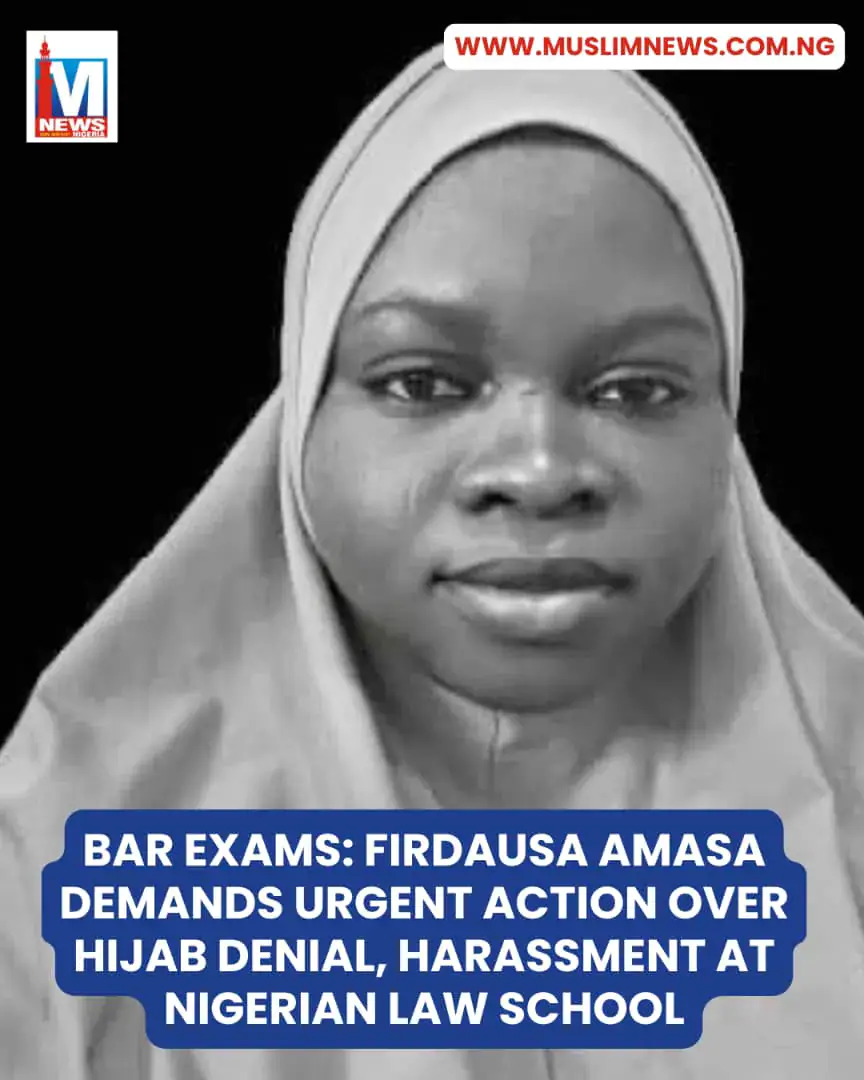
A disturbing incident has been reported at the Nigerian Law School, Bwari Campus, Abuja, where Muslim female candidates were allegedly forced to remove and rewrap their hijabs before being allowed into an examination hall. According to a report by lawyer Firdausa Amasa, who won the right to wear hijab at her 2018 Call to Bar ceremony, two female candidates were seen crying at the entrance due to harassment. Amasa visited the campus to observe compliance with a circular permitting candidates to write their Bar Part II examinations wearing hijab.
Amasa's report, dated October 31, 2026, stated that she visited five examination halls and found that female candidates in four of them were allowed to enter and write their examinations with their hijabs without hindrance. However, at the Main Hall, also known as the Multipurpose Hall, female candidates wearing hijab were stopped at the entrance and compelled to remove their head coverings and rewrap them like turbans before being allowed entry. This incident caused visible distress and destabilisation among the candidates shortly before a major examination.
Amasa's history in the hijab rights struggle is well-known, having fought and won the right to wear hijab at her 2018 Call to Bar ceremony. In 2017, she was initially denied participation in the Call to Bar ceremony because she insisted on wearing her hijab, generating national controversy. The Body of Benchers eventually approved her participation in June 2018, and she was called to the Nigerian Bar in July 2018 while wearing her hijab. Her successful struggle became a significant reference point in the campaign for Muslim women's right to wear hijab in educational and professional institutions.
The latest incident comes amid renewed concerns over the treatment of Muslim female candidates during the 2026 Bar examinations. The Muslim Public Affairs Centre (MPAC) Nigeria and the Muslim Students' Society of Nigeria (MSSN), B-Zone, have also raised concerns over reported restrictions. Amasa described the action of the supervisors in the Multipurpose Hall as unconstitutional and unlawful, arguing that it contradicted both the Nigerian Law School's circular and the provisions of the Constitution.
Amasa cited Sections 38(1) and (2) of the 1999 Constitution, as amended, which guarantee freedom of thought, conscience and religion, including the freedom to manifest and propagate one's religion. She also referenced the Supreme Court judgment in Lagos State Government & Ors v. Asiyat Abdulkareem (SC/910/2016), delivered in 2022, which affirmed the right of Muslim female students to wear hijab in public schools. According to Amasa, the reported action also amounted to discrimination and harassment contrary to Section 42 of the Constitution.
Amasa urged the management of the Nigerian Law School to call the supervisors of the Multipurpose Hall to order and ensure compliance with the hijab directive across all examination halls for the remaining papers. She also requested that a clear and unconditional instruction be reissued to all invigilators, stating that candidates wearing hijab must be allowed to enter and write their examinations as permitted by law. Amasa further called for assurances that no candidate would be victimised or disadvantaged for exercising her constitutional right.
The Nigerian Law School had yet to issue an official response to the incident report at the time of publication. Amasa commended the Nigerian Law School for issuing the initial circular permitting hijab but noted that its inconsistent implementation, particularly in the Multipurpose Hall, undermined the effort. "This must be stopped immediately," she stated.
Key points
- The incident at the Nigerian Law School contradicts the constitutional provisions guaranteeing freedom of thought, conscience, and religion.
- The Supreme Court judgment in 2022 affirmed the right of Muslim female students to wear hijab in public schools.
- Amasa urges the management of the Nigerian Law School to ensure compliance with the hijab directive and prevent further incidents.