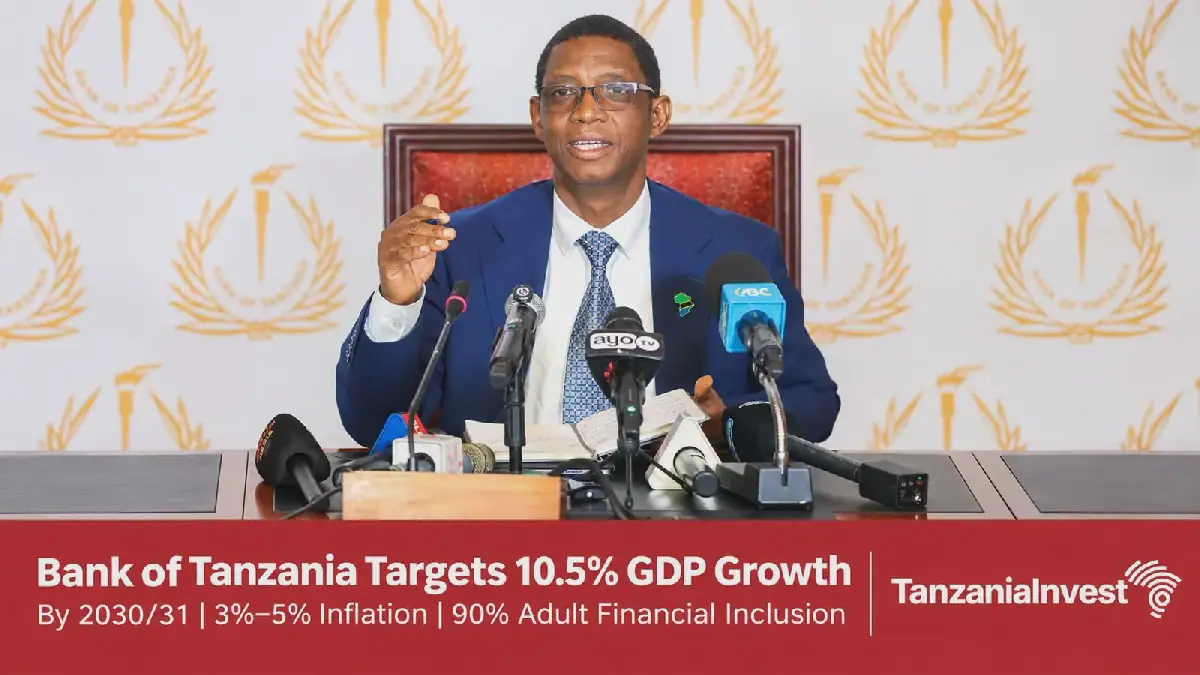
The Bank of Tanzania has set ambitious targets under its Vision 2050 plan, aiming for a real GDP growth rate of 10.5% by 2030/31, up from 7.2% currently. The plan, outlined by Governor Emmanuel Tutuba in the central bank's quarterly magazine Uchumi Wetu, also targets an annual inflation rate of 3-5% from 2026/27. This vision seeks to build an upper-middle-income economy that is diversified, resilient, inclusive, and competitive.
To achieve these goals, the Bank of Tanzania will focus on improving monetary policy effectiveness through research, statistics, and innovation. The central bank aims to maintain low and stable inflation, a stable seven-day money market interest rate, and rising private sector credit. Additionally, it plans to expand its sources of foreign exchange by supporting higher gold output and increasing the national gold reserve to raise foreign exchange reserves to more than four months of import cover.
The financial sector will play a crucial role in Vision 2050, serving as the main channel for capital and credit. The Bank of Tanzania will work to strengthen the stability of the financial sector and the macro economy to make it easier for businesses, investors, and producers to access funds and capital. This includes setting a capital adequacy ratio above 16.5% for financial institutions and non-performing loans below 5%, alongside higher lending to the private sector.
Private sector credit growth has been strong, averaging 32.5% in the quarter ending September 2026, while non-performing loans stood at 2.5% in August 2026. The Bank of Tanzania aims to reach 90% adult financial inclusion by 2030/31, with formal access to financial services reaching at least 96%. This will be achieved by expanding the use of digital payments, strengthening financial education, and reducing the share of loans that borrowers cannot repay.
The central bank will also prioritize the use of digital payment systems and electronic transfers of money to increase efficiency, transparency, and access to financial services. It plans to expand its use of artificial intelligence, digital innovation, and other emerging technologies in its banking operations, while giving priority to the digital economy and cybersecurity. A climate data repository and tools to analyze the effects of climate change on the financial sector will also be developed.
The Bank of Tanzania will measure progress against various indicators, including inflation, GDP growth, foreign exchange reserves, private sector credit, bank deposits, non-performing loans, financial inclusion, and the use of digital payments. President Samia Suluhu Hassan launched Tanzania's Development Vision 2050 on 17 July 2025, a 25-year roadmap to take the economy to upper-middle-income status and a size of USD 1 trillion by 2050.
The government's first medium-term plan under Vision 2050 covers 2026/27 to 2030/31, with an allocated TZS 12.50 trillion to launch it in 2026/27. The Bank of Tanzania's separate Strategic Plan 2025/26 to 2029/30 sets performance targets of inflation between 3-5%, reserves covering at least four months of imports, and 87% of adults with access to transactable financial accounts.
Key points
- The Bank of Tanzania aims for 10.5% GDP growth and 90% financial inclusion by 2030/31.
- The central bank will prioritize digital payments, artificial intelligence, and climate change resilience.
- Vision 2050 seeks to build an upper-middle-income economy that is diversified, resilient, inclusive, and competitive.