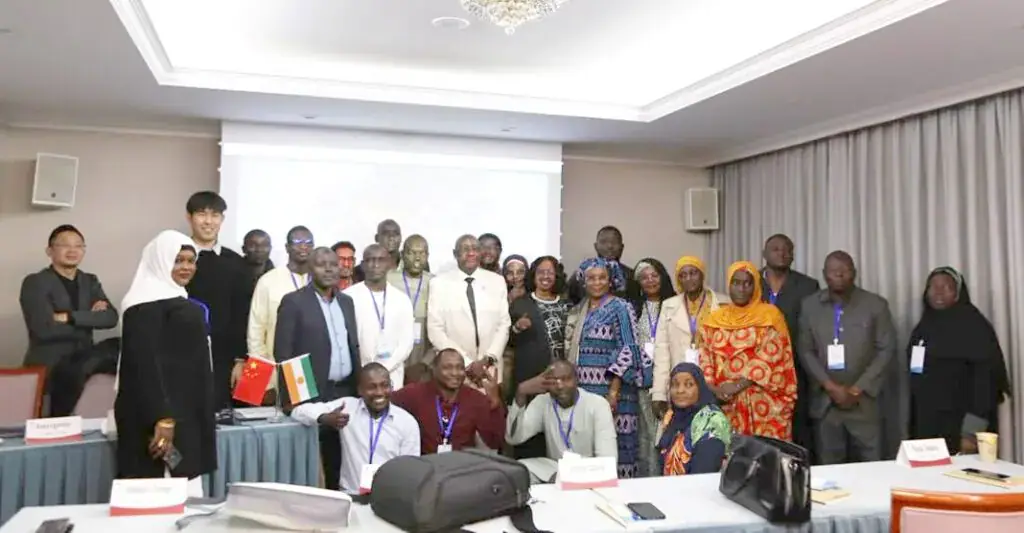
The China-Niger bilateral seminar, held in Beijing from November 10 to 30, has brought together Nigerien officials and journalists to discuss economic and commercial cooperation between China and Africa. On November 12, a presentation by Tian Yilin, associate researcher at the Chinese Academy of International Trade and Economic Cooperation, highlighted the significance of this cooperation, describing it as the "lest" that stabilizes the China-Africa cooperation ship. This cooperation has been sustained for 17 consecutive years, with China being Africa's largest trading partner.
In 2025, China-Africa trade reached a record $348.1 billion, with Chinese direct investments in Africa amounting to $43.4 billion. Over 3,500 Chinese enterprises operate in Africa, creating jobs and improving livelihoods. Tian Yilin emphasized that the "lest" plays a four-fold role: stabilizing relations, promoting industrialization, connecting people's interests, and providing a stable and open market for enterprises. This cooperation is built on mutual political support and concrete economic ties, including infrastructure projects, factories, and e-commerce platforms.
The Forum on China-Africa Cooperation (FOCAC) is a key institutional framework that has elevated China-Africa relations to a community of shared destiny. The 2024 Beijing Summit launched the "10 Partnership Actions," with four focusing on economic cooperation: trade, industrialization, connectivity, and development cooperation. In 2025, the Changsha meeting announced the exemption of customs duties on 100% of tariff lines for 53 African countries with diplomatic ties with China. This move has already shown positive effects, with China-Africa trade reaching $203.5 billion in the first half of 2026.
The exemption of customs duties is a significant institutional leap, from 33 to 53 countries. The "Green Channel 2.0" aims to streamline the entire trade chain, reducing clearance times for perishable products. African products such as dried peppers, cashews, and coffee have benefited from this initiative. At the Pudong airport customs in Shanghai, clearance times for fresh products have decreased from 7-14 days to 2-3 days.
Tian Yilin stressed the shift from "preferences" to "rules," ensuring that benefits are embedded in agreements. The China-Africa Deepening Economic and Trade Cooperation Pilot Zone and the Framework Agreement on Partnership for Common Development and Economic Cooperation, signed with 38 countries, demonstrate this approach. In March 2026, China and Kenya signed anticipated results, with Kenya becoming the second African country to conclude such an arrangement.
The results of China-Africa cooperation are visible in various sectors, including infrastructure, energy, industry, agriculture, and digital technology. Examples include the Naivasha-Malaba railway in Kenya, the Kribi port in Cameroon, and over 50 industrial parks involving Chinese participation. In Guinea, Chad, and Madagascar, Chinese assistance has improved rice production. China has also modernized over 150,000 km of networks, benefiting around 700 million users.
The case of Niger illustrates the success of China-Africa cooperation, with trade between the two countries reaching $1.074 billion in 2025, a 28.4% increase. Niger supplies China with crude oil and oilseeds, while China exports machinery, equipment, and grains to Niger. The sesame trade is a notable example, with Niger being China's largest supplier of imported sesame, accounting for 26.7% of Africa's sesame exports to China.
Key points
- China and Africa have strengthened economic ties through institutional frameworks and trade agreements, with China being Africa's largest trading partner for 17 consecutive years.