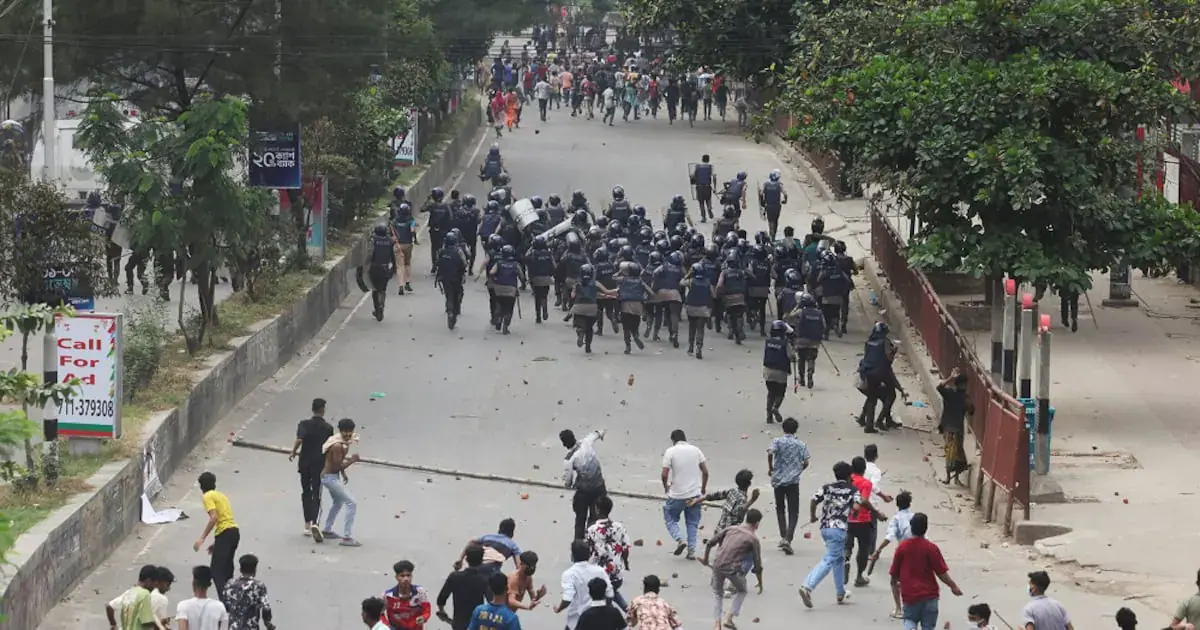
The Bangladesh government has established a wage board to review the salaries of garment workers, following violent protests that led to the closure of over 500 factories. The protests, which involved thousands of workers, were sparked by demands for a minimum monthly wage of 30,000 taka ($245), more than double the current 12,500 taka. The wage board, comprising representatives from workers, employers, and the government, has been tasked with recommending revised pay rates. The protests resulted in police using tear gas and water cannons to disperse demonstrators.
The garment industry, which employs around 4 million workers and generates over 80% of Bangladesh's export earnings, has been severely impacted by the protests. The closures have left 987,190 workers out of work across the country's main industrial hubs, according to the Bangladesh Garment Manufacturers and Exporters Association. Labour and employment minister Ariful Haque Choudhury urged workers to resume work, stating that the wage board was formed after discussions with workers' representatives and industry leaders.
The protests were sparked by concerns over the rising cost of living, with workers stating that their purchasing power has been sharply eroded due to increasing costs of food, housing, transport, and healthcare. Worker Mahin Hossain said that after paying rent, there is very little left for food, children's education, and other essential expenses. Many workers are finding it difficult to support their families, leading to demands for a higher minimum wage.
Despite the announcement of the wage board, thousands of garment workers continued to stage demonstrations, blocking roads and disrupting transport across key industrial areas. Police used tear gas and water cannons to disperse protesters, and a police vehicle and a police box were set on fire in separate incidents. Authorities deployed Border Guard Bangladesh personnel to maintain order.
The unrest has raised concerns about the impact on export shipments and payments from international buyers. Minister Choudhury warned that prolonged disruptions could delay shipments and create further difficulties for manufacturers and workers alike. Bangladesh's ready-made garment industry, the world's largest after China, contributes around 10% of the country's gross domestic product and is the backbone of the economy.
Manufacturers, however, are opposed to the workers' demand for a 30,000-taka minimum wage, stating that it would put additional strain on already tight margins. Salim Rahman, first vice president of the manufacturers' association, said that there is no logical or mathematical basis for such a demand, and that it would make it difficult for manufacturers to compete with rival apparel-producing countries.
The wage board has been tasked with reviewing wages in the garment sector and recommending revised pay rates. The six-member board comprises two representatives each from workers and employers, along with a government representative and a neutral member. The outcome of the wage board's review is expected to have a significant impact on the livelihoods of millions of garment workers in Bangladesh.
Key points
- The Bangladesh government has established a wage board to review garment workers' pay amid protests demanding a minimum monthly wage of 30,000 taka ($245).
- The protests have forced the closure of over 500 factories, leaving 987,190 workers out of work across the country's main industrial hubs.
- The garment industry, which employs around 4 million workers, generates over 80% of Bangladesh's export earnings and contributes around 10% of the country's gross domestic product.