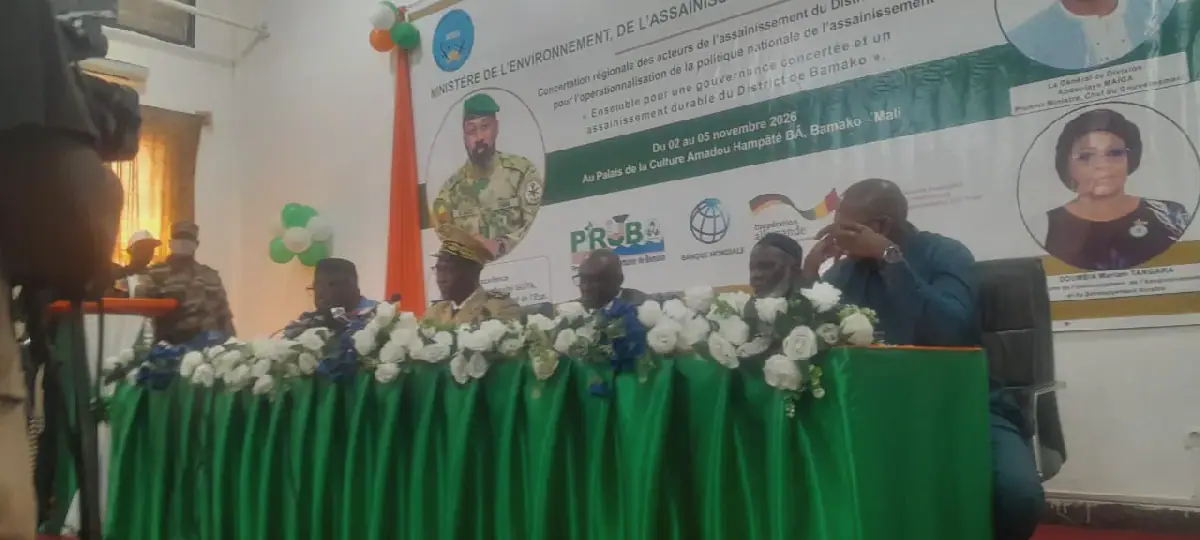
The regional consultation on sanitation for the Bamako district started on November 2 at the Amadou Hampâté Bâ Palace of Culture. The meeting, which will run until November 5, seeks to promote the appropriation and implementation of the National Sanitation Policy while strengthening coordination among stakeholders. The interim Secretary General of the Ministry of Environment, Sanitation, and Sustainable Development, Sékou Koné, officially opened the consultation.
The consultation aims to strengthen the strategic role of the Regional Sanitation Directorate in coordinating, controlling, and monitoring the sub-sector. It provides a platform for dialogue among administrative authorities, territorial collectives, technical services, private operators, civil society organizations, and development partners. This initiative addresses the challenges facing Bamako's sanitation, including population growth, habitat expansion, and economic activity intensification, which exacerbate waste management difficulties.
Sékou Koné highlighted the pressing challenges facing Bamako's sanitation infrastructure and services. He noted that the difficulties are not solely due to a lack of infrastructure but also stem from inadequate coordination, financing, equipment maintenance, and unclear responsibilities among stakeholders. Koné called for a shift from isolated and curative approaches to a coherent, integrated, and sustainable sanitation system with clearly defined responsibilities.
The President of the Transition has expressed a desire to boost the sanitation sector by enhancing governance, preventing pollution, improving services, valorizing waste, mobilizing innovative financing, and promoting citizen participation. Issa Sissoko, director of the Mali Sanya program of German technical cooperation (GIZ), emphasized that investments in infrastructure alone cannot guarantee sustainable sanitation improvements without effective coordination among stakeholders.
Sissoko advocated for a comprehensive approach incorporating institutional, technical, financial, economic, environmental, and social dimensions of sanitation. The support of technical and financial partners focuses on these areas to ensure a sustainable impact. The consultation provides an opportunity for stakeholders to discuss and address the complex challenges facing Bamako's sanitation sector.
The meeting will enable participants to share experiences, identify best practices, and develop strategies to overcome the obstacles hindering effective sanitation in Bamako. By working together, stakeholders aim to create a more efficient and sustainable sanitation system that addresses the needs of the local population.
Key points
- The consultation aims to strengthen coordination among stakeholders to improve sanitation in Bamako.
- The meeting seeks to promote the implementation of Mali's national sanitation policy.
- Stakeholders emphasize the need for a comprehensive approach to address sanitation challenges.