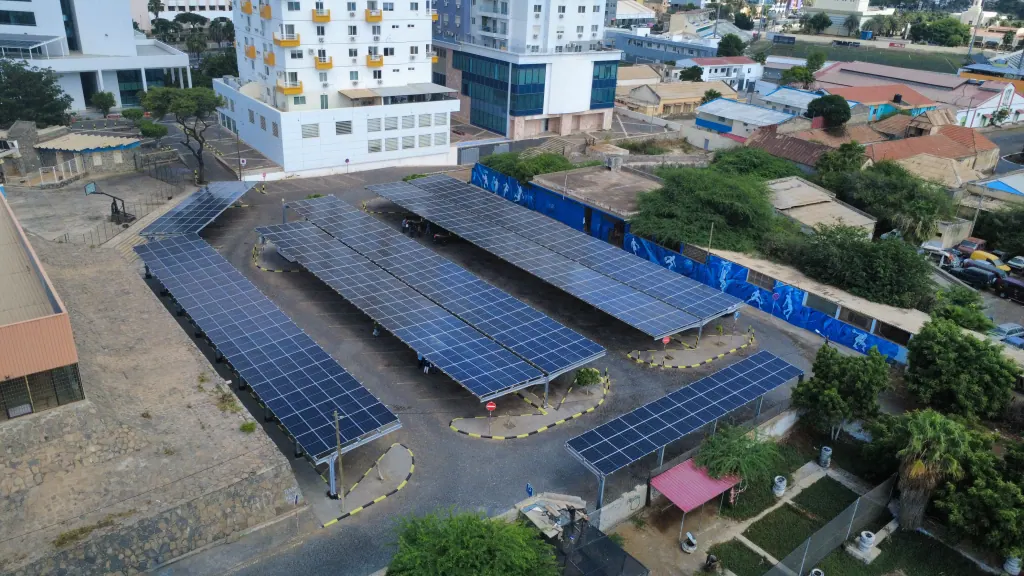
The BAI Cabo Verde (BAICV) has completed a project to requalify the parking area behind the Gimno Desportivo in Praia, Cabo Verde. The project combined the installation of a photovoltaic system with improvements to the space and the enhancement of murals associated with sports practiced at the Vavá Duarte Sports Pavilion. This initiative represents a total investment of 28 million escudos and was developed in two phases. The project aims to promote sustainability and energy efficiency.
The first phase involved the implementation of the Gimno Desportivo Photovoltaic Park. BAICV financed ARES (Atlantic Renewable Energy) with approximately 15 million escudos to install 400 solar panels with an initial installed capacity of 220 kWp. The bank estimates that this system will result in an annual savings of around 1.4 million escudos in energy costs. This phase focused on harnessing renewable energy to power the facility.
The second phase was part of the BAICV's Photovoltaic System Expansion Project and involved an additional investment of 13 million escudos. An additional 80 solar panels were installed, corresponding to an initial capacity of 47 kWp. This component is expected to generate an estimated annual savings of 2.067 million escudos in energy costs. The project has significantly increased the facility's energy efficiency.
Beyond the energy component, the project aimed to improve the utilization of the space. The installed solar panels also serve as shading structures for the parking area, while the waste disposal area was rehabilitated and equipped with new containers. The project included the recovery and painting of murals depicting various sports practiced at the Vavá Duarte Sports Pavilion. Local artist Tutu Sousa executed the paintings using donations from SITA.
The Câmara Municipal da Praia partnered with BAICV, facilitating the intervention and creating conditions for the requalification of the space. ARES was involved in developing and implementing the structural component of the project, including identifying and mobilizing solutions and suppliers for the photovoltaic system. The collaboration between institutions and companies was crucial to the project's success.
For BAICV, the initiative aligns with its strategy of social, environmental, and governance responsibility, seeking to associate energy efficiency with the improvement of public use spaces. The bank considers that the intervention demonstrates the impact of collaboration between public institutions, companies, and cultural agents in creating more functional and sustainable spaces.
The completed project integrates an initial photovoltaic capacity of 267 kWp and a total of 480 solar panels. The estimated annual energy savings from the project exceed 3.4 million escudos. The initiative showcases BAICV's commitment to sustainability and its potential for replication in other projects.
Key points
- The project combines a photovoltaic system with infrastructure improvements and art, demonstrating a holistic approach to sustainability.
- The initiative is part of BAICV's strategy to promote social, environmental, and governance responsibility.
- The project is expected to generate significant annual energy savings and reduce the facility's environmental impact.