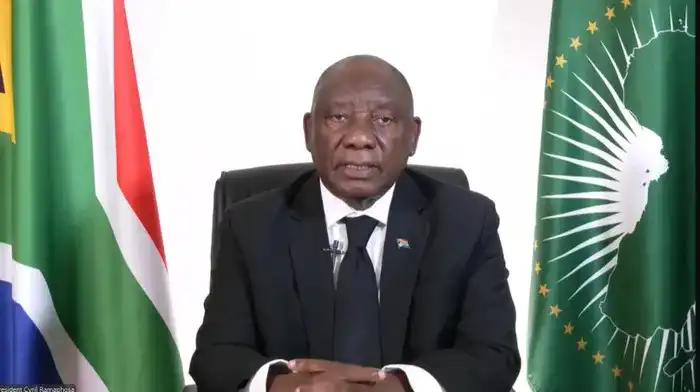
The African Union has called for the release of all persons arbitrarily detained on political grounds in South Sudan, ahead of the country's first general elections. The AU Committee on South Sudan, led by South African President Cyril Ramaphosa, convened a virtual summit to address the nation's transition to peace and stability. Ramaphosa apologized for postponing the meeting, citing health reasons.
Ramaphosa commended South Sudan's leadership for their commitment to peace and stressed that AU member states have a collective responsibility to support the nation. He welcomed AU Commission Chairperson Mahmoud Ali Youssouf, South Sudan's President Salva Kiir Mayardit, and other dignitaries to the summit. The meeting aimed to address significant developments in the country, including the dissolution of the Transitional Government and amendments to the National Elections Act.
The AU has emphasized that credible elections require a foundation of stability, security arrangements, and protection of electoral staff and civilians. Ramaphosa stated that voting alone cannot secure the nation's future, and that a genuine, inclusive political process is necessary. He urged leaders to come together to discuss challenges and problems standing in the way of their advancement as a nation.
The summit yielded a concrete Declaration with strict recommendations, following briefings from President Kiir, the AU, and former Nigerian Foreign Minister Geoffrey Onyeama. Onyeama led the AU's technical pre-election and needs assessment mission in Juba in August. The Declaration aims to guide South Sudan's transition to peace and stability.
Ramaphosa confirmed that the Revitalised Agreement on the Resolution of Conflict in South Sudan (R-ARCSS) remains the foundational document for the country's transition. He noted that support for the agreement has grown across the continent since the inaugural C5 Plus Summit earlier this year. The agreement is the only internationally recognized framework for South Sudan's transition.
The AU has appointed former Tanzanian President Jakaya Kikwete as the new High Representative for the Horn of Africa and the Red Sea. Ramaphosa expressed his confidence in Kikwete's ability to assist the government and people of South Sudan, leveraging his extensive expertise and energies. Kikwete's role will be crucial in supporting South Sudan's transition.
The African Union's call for the release of political detainees and a halt to hostilities aims to create a conducive environment for South Sudan's first post-independence elections. The country's leadership faces significant challenges in ensuring a peaceful and credible electoral process. The AU's recommendations and support will be essential in guiding South Sudan towards stability and democracy.
Key points
- The African Union has called for the release of all persons arbitrarily detained on political grounds in South Sudan.
- The AU has emphasized that credible elections require a foundation of stability, security arrangements, and protection of electoral staff and civilians.
- The Revitalised Agreement on the Resolution of Conflict in South Sudan (R-ARCSS) remains the foundational document for the country's transition.